


Drywall Estimating: Improving Material Accuracy and Budget Control from Blueprint to Build
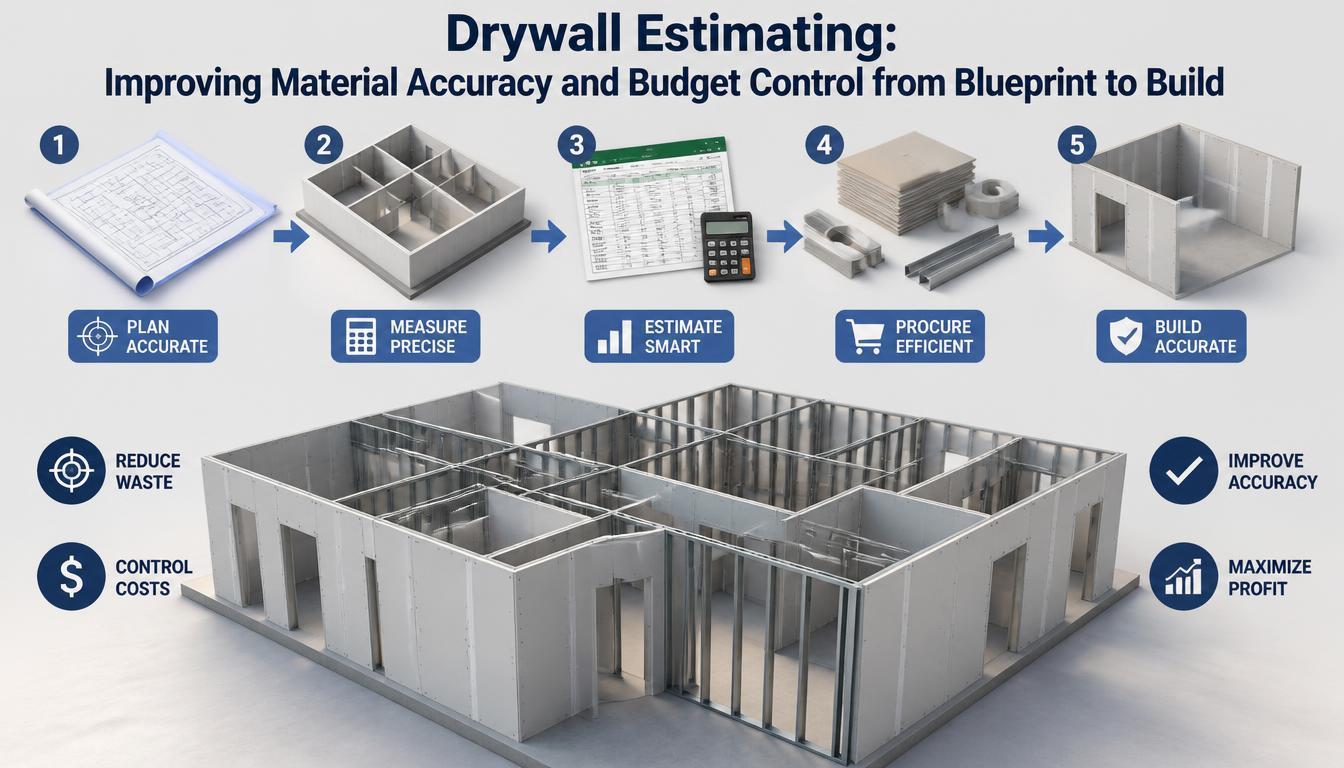
Inaccurate blueprint measurements can compound across hundreds of sheets, rooms, corners, and ceilings. Drywall estimating ensures that contractors can identify such inaccuracies before they translate into shortages of material, labor, and costly changes.
Drywall estimating services of Universe Estimating makes it easier for contractors by using a systematic approach of linking blueprint quantities to labor costs, material costs and waste costs.
How Does Drywall Estimating Improve Blueprint Accuracy?
Accurate quantities begin with disciplined blueprint review. Estimators should trace wall and ceiling areas rather than rely on broad square-foot assumptions. This process should identify the following:
-
Wall and ceiling dimensions
-
Board thickness and type
-
Openings for doors and windows
-
Partitions and soffits
-
Ceiling changes and bulkheads
-
Fixings, joint treatment, and fixtures
-
Locations where moisture-, fire-, or impact-resistant panels are needed
Drawings must be verified. If a wall appears differently across two drawings, reviewing only one can create quantity discrepancies.
It's important to separate quantities by material type, location, and application. That makes procurement easier and gives project teams a clearer basis for comparing revisions.
What Should Be Included In A Reliable Quantity Takeoff?
A useful takeoff goes beyond counting drywall sheets. It connects measured quantities to the actual installation requirements shown in the construction documents.
Example: A corridor may require different materials than a standard office. Some rooms may require moisture-resistant materials; however, specific materials and thicknesses will be required for rated assemblies.
Therefore, accurate drywall cost estimation includes material selection, labor, screws, finishing materials, equipment, and waste.
Here is what a practical workflow looks like:
1. Review architectural plans and specifications.
2. Measure wall and ceiling surfaces.
3. Deduct clearly identified openings.
4. Classify boards by type and thickness.
5. Calculate accessories and finishing materials.
6. Apply documented waste assumptions.
7. Price labor using the project location and production requirements.
8. Reconcile quantities against drawings before finalizing the estimate.
This approach can also reveal when a small material variance is masking a larger labor or sourcing issue.
How Does Accurate Estimating Strengthen Budget Control?
Budget control improves when the estimate shows exactly what drives the drywall package. A contractor can then compare planned quantities with purchased and installed quantities during construction.
According to BLS May 2025 data, the median annual wage for drywall and ceiling tile installers was $58,930, while that of tapers was $68,270. (Bureau of Labor Statistics)
Labor should therefore receive the same attention as board quantities. Productivity can change with ceiling height, layout complexity, access restrictions, sequencing, and finishing requirements. A strong drywall budget control process tracks the following:
-
Estimated versus purchased material
-
Estimated versus installed quantities
-
Labor hours against planned hours
-
Approved changes
-
Material price changes
-
Unused or excess materials
This turns the estimate into a useful cost-control reference, giving contractors a clearer view of drywall project cost as work progresses.
What Do Recent Labor Wages Look Like Across U.S. States?
Labor costs for drywall vary by location, making state-specific wage data useful when building a project estimate. The latest BLS data show a meaningful spread in installer wages across U.S. markets.
|
State |
2025 Median Hourly Wage |
2025 Median Annual Wage |
2025 90th-Percentile Hourly Wage |
|
California |
$31.67 |
$65,880 |
$57.81 |
|
Texas |
$22.88 |
$47,590 |
$29.34 |
|
Florida |
$23.54 |
$48,970 |
$29.58 |
|
New York |
$29.46 |
$61,280 |
$45.69 |
The wage data for drywall and ceiling tile installers is provided by the Bureau of Labor Statistics as recorded in the occupational wage system of the Department of Labor.
They provide labor-market reference points and cannot be confused with contractors’ billing rates or complete installed costs. Material costs, productivity of labor, delivery costs, and overhead are also needed to prepare project cost estimates.
How Can Contractors Ensure Accuracy in Construction?
The best estimate remains useful after the bid is submitted. Both the estimators and the construction team will be able to reconcile the takeoff quantities with the purchase orders, deliveries, site quantities, and revised drawings.
This makes it possible for quantity changes to be isolated easily from their cost consequences.
Concluding Remarks
Precise drywall estimating links the measurements derived from the blueprint to the actual requirements of materials and labor, so contractors get a clear picture of quantities, costs, and project requirements. The method can help reduce costly mistakes, enhance planning, and ensure better control over the project costs, from bidding to procurement and construction.

 English
 Arabic
 French
 Spanish
 Portuguese
 Deutsch
 Turkish
 Italiano
 Russian
 Romaian
 Portuguese (Brazil)
 Greek