


What latest technologies can be incorporated into modern IVF Lab Design?
INTRODUCTION
Modern IVF Lab Design is evolving with advanced embryology equipment, artificial intelligence (AI), automated witnessing systems, time-lapse embryo monitoring, smart environmental controls, and integrated laboratory management software. These technologies help fertility clinics create controlled, efficient, and traceable environments for handling eggs, sperm, and embryos. A modern IVF laboratory must combine advanced equipment with appropriate air quality, stable culture conditions, contamination control, reliable utilities, and carefully planned workflows.
The objective of technology-driven IVF Lab Design is not simply to install the newest equipment. It is to create a laboratory that supports consistent procedures, protects reproductive cells from avoidable environmental disturbances, improves traceability, and enables embryologists to make informed decisions. The most suitable technologies depend on the clinic's treatment volume, clinical services, budget, staff expertise, and available evidence of clinical benefit.
Why Technology Matters in Modern IVF Laboratories
An IVF laboratory requires precise control over multiple environmental and operational factors. Eggs, sperm, and embryos are sensitive to changes in temperature, pH, gas concentrations, and other culture conditions. Laboratory design must therefore support careful handling, minimize unnecessary movement, and reduce exposure to uncontrolled environmental conditions.
The 2026 European Society of Human Reproduction and Embryology (ESHRE) recommendations on good practice in the IVF laboratory emphasize appropriate laboratory layout, air quality, equipment qualification, monitoring, and maintenance. These recommendations provide a useful reference when planning new laboratories or upgrading existing facilities.
Technology can help fertility clinics improve:
-
Environmental monitoring and control
-
Embryo culture consistency
-
Sample identification and traceability
-
Workflow efficiency
-
Equipment maintenance planning
-
Documentation and quality assurance
-
Data management and operational oversight
However, technology must be selected according to the laboratory's actual needs rather than trends alone.
1. Artificial Intelligence for Embryo Assessment
Artificial intelligence is one of the most discussed developments in reproductive laboratory technology. AI systems can analyze embryo images, time-lapse observations, and selected laboratory data to assist embryologists with embryo assessment.
Depending on the system, potential applications include:
-
Automated analysis of embryo morphology
-
Identification of developmental milestones
-
Standardization of embryo-ranking processes
-
Organization of embryology data
-
Decision-support tools for embryo assessment
AI models may help identify patterns that are difficult to assess consistently through manual observation. They can also support standardized workflows across laboratories when properly evaluated and implemented.
Nevertheless, AI should be treated as a decision-support tool, not a replacement for qualified embryologists. Performance may vary between clinics, patient populations, imaging systems, and datasets. Predictions must be interpreted within the clinical context.
The American Society for Reproductive Medicine (ASRM) has emphasized caution when interpreting AI research because promising retrospective results do not automatically establish improved clinical outcomes. Clinics should evaluate the validation evidence, limitations, transparency, and intended use of any AI product before adoption.
2. Time-Lapse Embryo Monitoring Systems
Time-lapse embryo monitoring combines an incubator with an integrated imaging system that records embryo development at scheduled intervals. Embryologists can review developmental patterns without repeatedly removing embryos from the incubator for conventional observation.
Potential advantages include:
-
Continuous documentation of embryo development
-
Reduced need for routine removal from the incubator
-
Detailed records of developmental timing
-
Support for standardized assessment
-
Convenient review of embryo-development data
When combined with suitable analytical software, time-lapse systems may also support AI-assisted embryo assessment.
However, time-lapse monitoring should not automatically be considered superior to every conventional incubation system. A 2025 review described its potential for detailed developmental observation while highlighting continuing challenges in predicting implantation and clinical outcomes. Evidence should be reviewed for the specific system and intended application.
During planning, clinics should assess the number of incubators required, recovery performance, maintenance requirements, image-storage needs, software compatibility, and total ownership costs.
3. Advanced Embryo Incubators
Incubators are among the most important equipment investments in an IVF laboratory. Modern systems may offer improved monitoring, smaller culture chambers, rapid recovery after access, and integrated alarms.
Depending on the selected model, useful features may include:
-
Precise temperature regulation
-
Controlled carbon dioxide and oxygen concentrations
-
Humidity management where applicable
-
Rapid recovery of culture conditions
-
Individual or compartmentalized culture areas
-
Integrated data recording
-
External alarm connectivity
Some laboratories use low-oxygen culture conditions to support embryo culture protocols. Gas settings and other parameters must be established according to validated procedures, equipment specifications, and the laboratory's clinical protocols.
The number and capacity of incubators should match the anticipated workload. Clinics should also plan for equipment redundancy, backup power, calibration, maintenance, and emergency procedures.
A modern incubator should be selected because it meets the laboratory's operational and culture requirements—not merely because it has more digital features.
4. Electronic Witnessing and Sample Traceability
Electronic witnessing systems help verify the identity of reproductive samples during critical laboratory procedures. These systems may use barcodes, radio-frequency identification, or other identification technologies to associate samples with the correct patient and procedural record.
Potential applications include:
-
Oocyte collection and identification
-
Sperm preparation
-
Insemination and intracytoplasmic sperm injection (ICSI)
-
Embryo movement between culture vessels
-
Embryo biopsy and cryopreservation
-
Warming and preparation for transfer
Depending on the system, an alert may notify staff when a sample identification or procedural step does not match the expected workflow.
Electronic witnessing can strengthen traceability and documentation, but it does not eliminate the need for validated procedures, staff training, system checks, and appropriate contingency arrangements.
The 2026 ASRM committee opinion on witnessing and protocol deviations discusses manual and electronic witnessing in the IVF and andrology laboratory. Clinics should evaluate whether a proposed system covers their critical steps and maintains reliable records.
5. Smart HVAC and Air-Quality Monitoring
Environmental engineering is as important as embryology equipment. Modern IVF Lab Design can incorporate advanced HVAC systems and monitoring tools to help maintain suitable environmental conditions.
Relevant features include:
-
HEPA filtration
-
Appropriate fresh-air supply
-
Controlled temperature and humidity
-
Suitable pressure relationships
-
Monitoring of environmental trends
-
Scheduled filter inspection and replacement
-
Continuous or periodic system-performance checks
Volatile organic compounds (VOCs) are also an important consideration because some airborne chemicals may be harmful to reproductive cells. Material selection, construction finishes, cleaning products, ventilation, and laboratory operating practices should therefore be assessed as part of contamination-control planning.
Where appropriate, clinics may install VOC monitoring or arrange periodic testing to investigate air-quality trends. The monitoring method and frequency should follow a documented risk assessment and the applicable laboratory requirements.
The latest ESHRE recommendations discuss HEPA filtration, VOC control, positive pressure, air-quality assessment, and the importance of suitable construction materials.
6. Integrated Environmental Sensors and Automated Alarms
Smart sensors can help laboratories track critical conditions and identify deviations before they become larger operational problems.
Monitoring systems may cover:
-
Incubator temperature
-
Carbon dioxide and oxygen concentrations
-
Laboratory temperature and humidity
-
Differential room pressure
-
Equipment status
-
Cryostorage conditions
-
Power supply and alarm status
An integrated platform may display measurements on a central dashboard and send alerts to designated staff when values move outside approved limits.
For example, a temperature alarm can help staff respond to an incubator deviation, while cryostorage monitoring can notify personnel of an abnormal tank condition. These systems are particularly useful when they operate continuously and have clear escalation procedures.
Clinics should confirm sensor accuracy, calibration intervals, alarm routing, backup power, data retention, and response responsibilities. Monitoring is valuable only when staff can interpret alerts and act promptly.
7. Laboratory Information Management Systems
Laboratory information management software can connect sample records, equipment logs, treatment-cycle information, quality documentation, and procedural records.
Depending on the platform, it may provide:
-
Patient and sample identification
-
Embryology procedure records
-
Culture and assessment documentation
-
Cryopreservation inventory
-
Equipment maintenance logs
-
Quality indicators and reports
-
Audit trails and access controls
Integrated software can reduce repetitive data entry and make records easier to retrieve. It may also help laboratory managers review performance trends and identify workflow problems.
Before implementation, clinics should check interoperability with existing clinical systems, data security, user permissions, backup procedures, and disaster recovery arrangements. Staff training is essential, and any digital workflow should be tested before it becomes part of routine clinical operations.
8. Automation in Embryology Procedures
Automation is increasingly being explored for repetitive or highly operator-dependent laboratory tasks. Current and emerging applications include automated or semi-automated sample handling, cryopreservation workflows, image analysis, and selected aspects of micromanipulation.
Potential benefits include:
-
More standardized procedural steps
-
Reduced repetitive workload
-
Consistent documentation
-
Support for workflow planning
-
Reduced variation in selected manual tasks
The level of automation varies considerably. Some systems assist embryologists with individual steps, while others aim to connect multiple stages of a laboratory workflow.
A 2026 review of IVF laboratory automation discusses embryo selection, vitrification and warming, ICSI, and integrated laboratory automation as distinct technology areas with different levels of evidence.
Clinics should review clinical evidence, equipment qualification requirements, staff competency needs, service availability, and failure-recovery procedures before investing in automation. Human oversight remains essential for clinical decisions and safe handling of reproductive material.
9. Modern Cryopreservation and Storage Monitoring
Cryopreservation systems support the storage of embryos, oocytes, and sperm for future clinical use. Modern laboratory planning should address both the storage equipment and the supporting monitoring infrastructure.
Useful features may include:
-
Secure cryostorage vessels
-
Continuous or frequent condition monitoring
-
External alarm systems
-
Digital inventory management
-
Backup storage planning
-
Emergency response procedures
-
Documented access and identification records
Cryostorage should be located in an appropriately planned area with suitable access, safety measures, and monitoring. Clinics should consider the number of storage vessels required, anticipated future demand, gas supply arrangements, and the procedures for responding to equipment or environmental deviations.
A digital inventory system can improve traceability, but its records must be reconciled with validated laboratory procedures and physical identification practices.
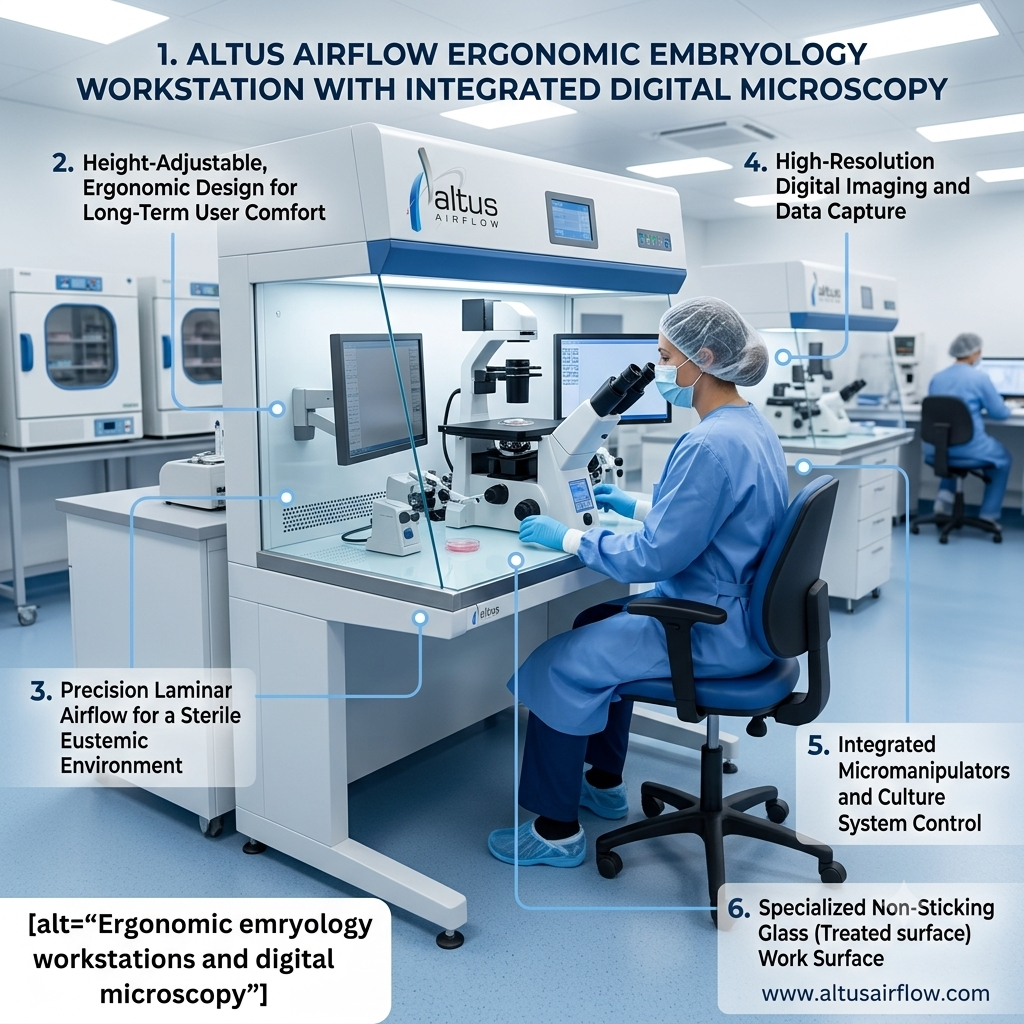
10. Ergonomic Workstations and Digital Microscopy
Technology planning should also improve the working environment for embryologists. Ergonomically designed workstations can help reduce unnecessary movement, discomfort, and fatigue during delicate procedures.
Possible features include:
-
Adjustable seating and bench arrangements
-
Appropriate microscope positioning
-
Digital microscopy and image capture
-
Controlled work-surface lighting
-
Convenient access to frequently used equipment
-
Organized storage and cable management
Digital microscopy can support documentation, training, image review, and collaboration where appropriate. Workstations should be arranged so that equipment placement does not obstruct clean workflows or compromise access to essential utilities.
Ergonomics is not simply a comfort feature. A well-planned work area can help reduce avoidable distractions and support consistent laboratory practices.
11. Modular Construction and Future-Ready Laboratory Infrastructure
A modern IVF laboratory should be designed to accommodate current needs while allowing practical future upgrades. Modular construction and coordinated service planning can help organize laboratory zones, technical areas, and equipment access.
Planning considerations include:
-
Appropriate zoning for laboratory activities
-
Cleanable, low-emission construction materials
-
Suitable flooring, walls, ceilings, and work surfaces
-
Accessible HVAC and electrical services
-
Space for equipment servicing
-
Provisions for future utility upgrades
-
Separation of technical and support areas where required
Laboratory layout should minimize the time reproductive cells and tissues are handled outside controlled conditions. Equipment, cryostorage, staff movement, and clinical procedure areas should be coordinated during the design stage.
A modular approach may simplify selected renovations, but it does not remove the need for suitable engineering, commissioning, material assessment, and environmental validation.
12. How to Select the Right Technologies for an IVF Lab
Not every clinic needs every available technology. A practical selection process should start with clinical requirements and documented laboratory priorities.
Consider the following steps:
-
Define clinical services: Identify whether the laboratory will provide conventional IVF, ICSI, embryo culture, cryopreservation, or other services.
-
Assess expected workload: Estimate treatment volume, staff requirements, and equipment capacity.
-
Prioritize critical controls: Establish requirements for air quality, culture conditions, traceability, alarms, and backup systems.
-
Review clinical evidence: Distinguish demonstrated operational benefits from technologies whose clinical advantages remain uncertain.
-
Check compatibility: Confirm that new equipment and software can work with existing systems.
-
Calculate lifecycle costs: Include installation, consumables, maintenance, licensing, calibration, and staff training.
-
Plan validation and training: Qualify equipment, test workflows, document acceptance criteria, and train staff before routine use.
This approach helps clinics direct investment toward technologies that solve real problems and support reliable laboratory operations.
Conclusion
Modern IVF Lab Design can incorporate AI-assisted embryo assessment, time-lapse incubators, electronic witnessing, smart HVAC monitoring, integrated alarms, laboratory management software, automation, and advanced cryostorage systems. The best combination depends on the clinic's services, workload, budget, and validated operational requirements. Technology should complement—not replace—qualified embryologists, documented procedures, environmental control, and regular equipment maintenance. For fertility clinics planning modern laboratory infrastructure, Altus Airflow can be considered for specialized laboratory design and engineering solutions that support controlled, efficient, and future-ready environments.
Frequently Asked Questions
1. What latest technologies can be included in IVF Lab Design?
Modern IVF Lab Design may include AI-assisted embryo assessment, time-lapse incubators, electronic witnessing, environmental sensors, automated alarms, laboratory information management systems, and advanced cryostorage monitoring.
2. How does artificial intelligence support IVF Lab Design?
AI-supported tools incorporated into IVF Lab Design can assist with embryo image analysis, developmental assessment, and data organization. Their results require clinical interpretation, and evidence of improved patient outcomes should be evaluated carefully.
3. Why are time-lapse incubators useful in IVF Lab Design?
Time-lapse incubators in IVF Lab Design document embryo development at scheduled intervals and can reduce the need for routine removal from the incubator for observation. Their value should be assessed alongside clinical evidence, cost, and workflow requirements.
4. How can smart monitoring improve IVF Lab Design?
Smart monitoring in IVF Lab Design can track environmental conditions, incubator parameters, equipment status, and cryostorage alarms, helping staff identify deviations and respond according to documented procedures.
5. Is automation necessary for every IVF Lab Design project?
No. IVF Lab Design should prioritize technologies that match the clinic's clinical services, workload, budget, and quality requirements. Automation may be beneficial for selected procedures, but it requires appropriate validation and human oversight.
Read Our Previous Blog------>How can fertility clinics choose the right provider for Ophthalmic Modular Operation Theatre?

 English
 Arabic
 Spanish
 Portuguese
 Deutsch
 Turkish
 Dutch
Dutch
 Italiano
 Russian
 Romaian
 Portuguese (Brazil)
 Greek
Greek