


Careem Clone: Can One App Transform Local Mobility?
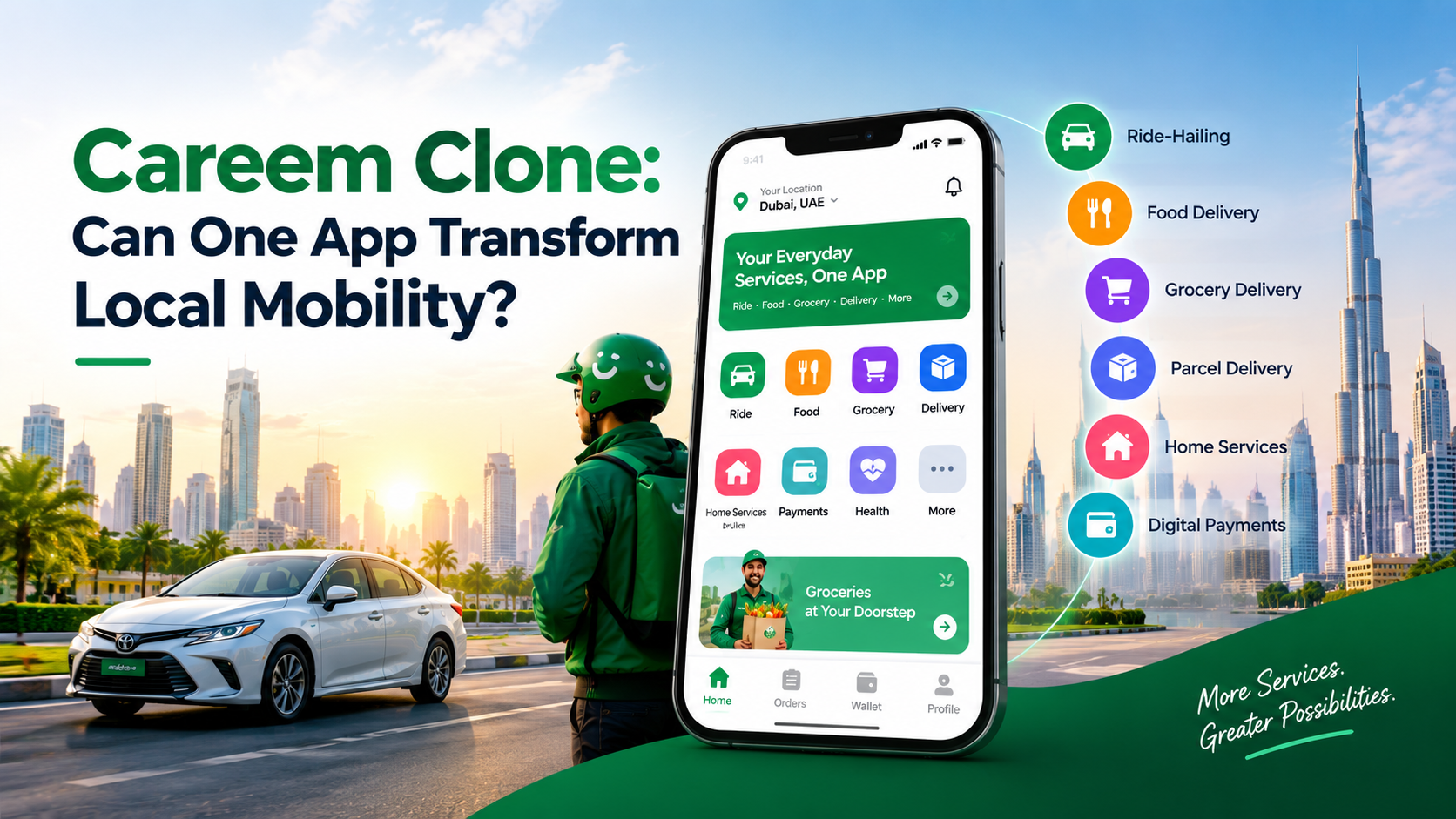
Most mobility startups do not fail because people dislike booking rides through an app. They struggle because one service rarely creates enough economic leverage on its own.
Drivers need consistent demand. Customers want availability. Businesses want predictable delivery capacity. Meanwhile, startups face rising acquisition costs while competing against established platforms.
This is why the Careem Clone concept is becoming more interesting from a business-model perspective.
The real opportunity is not to build another taxi-booking interface. It is to use mobility as the first layer of a local services network—and then monetize the infrastructure, customers, and supply network across multiple use cases.
The Hidden Asset in a Mobility Business Isn't the App
Consider what a ride-hailing company already possesses.
It has drivers distributed across geographic zones. It has customers requesting services at different times. It has real-time location information, dispatch capabilities, payment workflows, and a growing database of demand patterns.
That infrastructure does not have to remain limited to passenger transportation.
The same supply network could potentially support:
-
On-demand parcel delivery
-
Business logistics
-
Food delivery
-
Grocery fulfillment
-
Corporate transportation
-
Local courier services
-
Scheduled transportation
This changes the way entrepreneurs should think about a Careem Clone.
Instead of asking, “How can I copy a successful ride-hailing app?”, a better question is:
“What other transactions can my existing supply network perform?”
That question can lead to a much stronger expansion strategy.
The Next Competitive Battle Is Service Density
Super apps are often marketed around the number of services they provide.
But customers do not necessarily care whether an app offers 20 services.
They care whether the service they need is available when and where they need it.
This makes service density a critical growth factor.
Imagine a startup launching ride-hailing in one city. During peak hours, drivers are busy transporting passengers. During quieter periods, some of that same capacity may potentially support delivery or logistics operations, depending on the business model and local regulations.
Now the company is no longer thinking purely in terms of rides per driver.
It can begin thinking in terms of revenue opportunities per supply unit.
That is a completely different way of designing a mobility marketplace.
A customizable Careem Clone can provide the technological foundation for managing these different workflows, while the startup determines which combinations make commercial sense in its target market.
Don't Launch a Super App—Launch a Super-App Flywheel
One of the biggest mistakes startups make is attempting to launch every service simultaneously.
The result can be a platform with impressive functionality but insufficient activity.
A better model is to build a flywheel.
Start with one high-frequency service.
Build customer demand.
Attract enough service providers.
Increase geographic coverage.
Then introduce a complementary service that uses some of the same customers or supply.
For example:
Ride-hailing → Courier → Local Commerce → Business Logistics → Payments
The sequence can be completely different depending on the market.
A food-delivery startup might follow:
Food → Grocery → Courier → Local Retail → Mobility
The technology remains flexible while the business model evolves according to actual market signals.
This is much more practical than treating a super app as a checklist of features.
Why Driver Utilization Could Become a Major Growth Lever
Driver economics deserve more attention in the next generation of mobility platforms.
A driver who spends significant periods waiting for the next ride represents unused marketplace capacity. Increasing productive utilization can potentially improve driver earnings while giving the platform additional opportunities to generate revenue.
This is where multi-service infrastructure becomes strategically valuable.
If the platform can intelligently connect eligible drivers or delivery partners with different types of demand, the business can potentially reduce idle capacity.
The objective isn't necessarily to make drivers perform every possible service.
It is to create more relevant earning opportunities within the same ecosystem.
That could become especially valuable in markets where driver acquisition and retention are major operational challenges.
Local Data Can Become a Competitive Moat
There is another advantage that is frequently overlooked.
A localized super app can accumulate insights about how a particular market moves.
When do people travel?
Which neighborhoods generate delivery demand?
Where are supply shortages occurring?
Which services are frequently used together?
Which areas have high customer acquisition costs?
Which time periods produce excess driver capacity?
These signals can influence pricing, fleet allocation, service expansion, promotions, and operational planning.
Over time, the platform is no longer competing purely on app functionality.
It is competing through market intelligence.
That creates a potentially stronger moat than simply adding another feature to an application.
The Challenge: More Services Can Also Create More Problems
Multi-service platforms have a major downside: complexity.
Every new vertical introduces additional partners, support requirements, operational rules, pricing models, and regulatory considerations.
A startup therefore needs to avoid the temptation to expand simply because its technology allows it.
The right question is whether a new service strengthens the existing network.
Does it use existing customers?
Can existing supply support it?
Does it increase transaction frequency?
Does it create another revenue stream?
Does it improve retention?
If the answer is no, adding the service may simply increase operating costs.
This is why a scalable Careem Clone should be treated as business infrastructure rather than a finished business model.
The Careem Lesson for New Super App Startups
The most valuable lesson from the Careem-style model is not the number of services inside the platform.
It is the concept of progressive ecosystem expansion.
Start with a problem people already experience frequently. Build a reliable marketplace around it. Use the resulting customer relationships and operational infrastructure to solve the next related problem.
That approach can make a super app more defensible, because every successful vertical has the potential to strengthen another.
For entrepreneurs, this creates a more realistic path than attempting to become a complete super app overnight.
A Careem Clone can provide the foundation for this journey, but differentiation will ultimately come from the market chosen, service sequence, supply strategy, pricing, and ability to turn local demand into a connected ecosystem.
The Real Opportunity Is Between the Services
The next generation of super apps may not win because they offer the most services.
They may win because their services work better together.
A ride can lead to a delivery. A merchant can become a logistics customer. A driver can serve multiple demand channels. A frequent customer can move from transactions to membership.
That interconnectedness is where the real business opportunity lies.
For startups, the goal should therefore be bigger than launching a Careem-like application.
Build the infrastructure that allows one successful service to create demand for the next.
If you're planning to enter mobility or local commerce, a customizable Careem Clone can give your startup the foundation to launch, validate one vertical, and progressively build toward a market-specific super app.

 English
 Arabic
 French
 Spanish
 Portuguese
 Deutsch
 Turkish
 Italiano
 Russian
 Romaian
 Portuguese (Brazil)
 Greek
Greek