


How Vanity Lighting Complements Modern Mirrors and Contemporary Bathroom Interiors
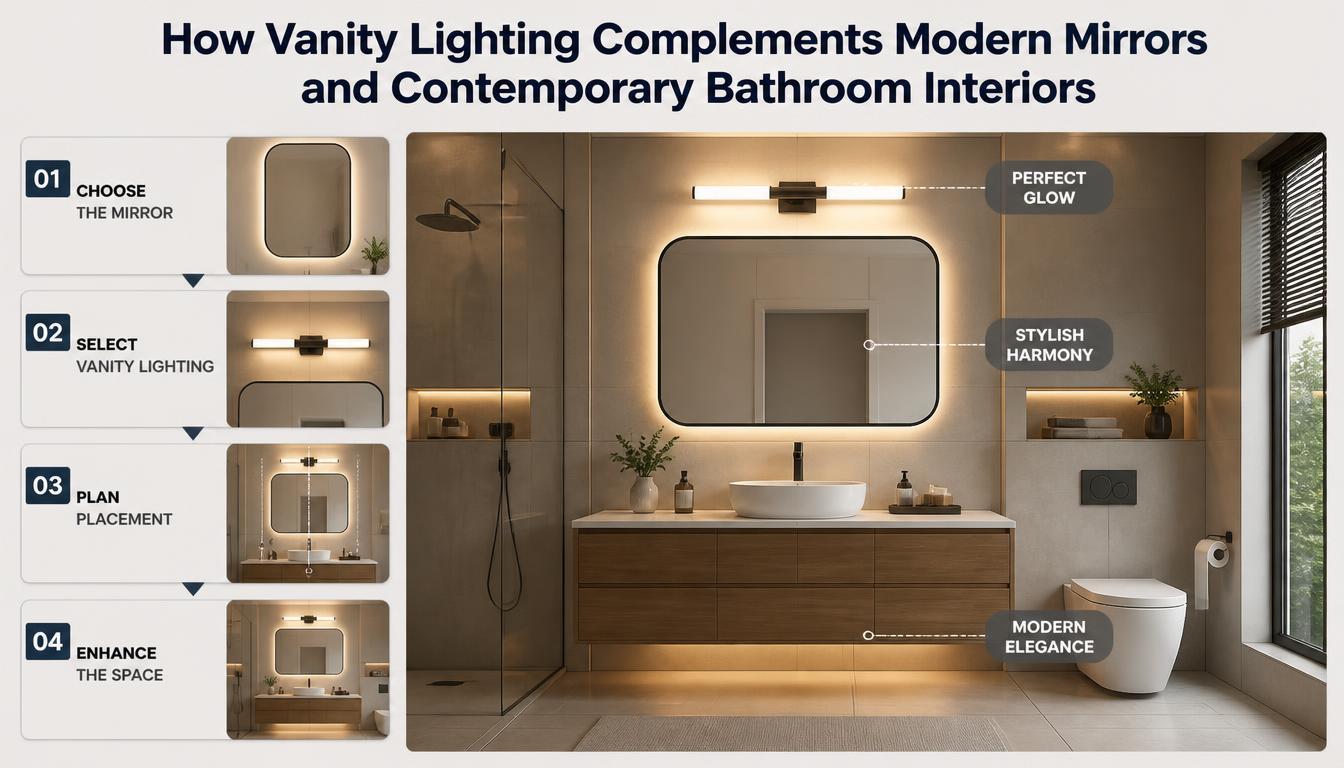
The purpose of vanity lighting is to enhance rather than distract from the mirror. It's worth considering the mirror's size alongside the wall's color and material before choosing a fixture.
One of the main aims is to provide illumination and complement any interior with any mirror type.
How Are Modern Mirrors Supported By Vanity Lighting?
Vanity lights are an excellent way to highlight a modern mirror.
A large mirror requires the type of lighting that has a horizontal shape, which will make it even more stunning. A tall mirror can feel more balanced when the fixture echoes its vertical proportions.
The fixture should also respect the mirror frame. A bold frame may need a restrained fixture, while a frameless mirror can support a more visible architectural element.
Bathroom & vanity lighting can connect the mirror to nearby finishes. Repeating a metal finish or geometric detail creates continuity without making every element look identical.
How Does This Light Improve the Mirror Wall?
An incomplete appearance can be given to a mirror wall if its fixture does not fit the design and style of the architecture.
The first thing to think about is the placement of the fixture in relation to the rim of the mirror, the countertop, and the width of the wall sections. The fixture might be very pretty but could look awkward if it does not blend with the room proportions.
Mirror illumination must be perceived as something that has been arranged logically rather than added later. A slim linear fixture can reinforce a minimalist mirror, while vertical fixtures can frame a larger reflective surface.
What Should You Improve Before Replacing Fixtures?
Before replacing fixtures, check these five things:
-
Check the fixture-to-mirror proportion.
-
Reduce visual clutter around the mirror.
-
Align fixtures with major architectural lines.
-
Consider the countertop and wall finish together.
-
Review the composition from normal standing height.
This approach creates a more professional look without a full redesign; here's what it improves:
|
Mirror Characteristic |
Complementary Approach |
Visual Result |
|
Frameless |
Slim, simple fixture |
Clean and quiet |
|
Bold frame |
Restrained fixture |
Strong focal point |
|
Wide shape |
Horizontal visual rhythm |
Greater continuity |
|
Tall shape |
Vertical visual rhythm |
Better proportion |
The key improvement is coordination. A fixture needs to look like it came with the mirror, not something that was found afterwards.
Why Does Fixture Style Matter In Contemporary Interiors?
Fixture style can strengthen the room’s architectural language when it repeats an existing shape, finish, or material.
Contemporary bathroom design often relies on controlled forms and fewer competing details. That makes fixture selection especially important because small visual differences become more noticeable.
For example, a cylindrical fixture may reinforce rounded hardware. A slim rectangular fixture can echo a rectangular mirror or linear cabinetry.
LED lighting also expands the range of compact fixture forms.
Residential LEDs can use at least 75% less energy and last 25 times longer than incandescent lighting. (U.S. Department of Energy)
Which Style Choices Create Stronger Visual Harmony?
The following will help in creating the desired visual harmony:
-
Repeat one material or finish.
-
Echo shapes already present in the room.
-
Choose simple silhouettes for busy interiors.
-
Use decorative fixtures where the wall needs emphasis.
-
Avoid mixing too many competing forms.
The result should feel coordinated, not perfectly matched. A bathroom can have personality without turning into a showroom catalog.
What Practical Details Should You Check?
A visually successful fixture still needs to suit its installation environment.
U.S. residential code provisions require luminaires in damp locations to prevent water from reaching electrical parts. Fixtures in those locations also need the appropriate suitability marking. (International Residential Code)
This makes the installation location part of the design decision, not a detail to consider afterwards. Here is what should be accounted for:
|
Design Check |
Why It Matters |
Improvement |
|
Scale |
Prevents visual imbalance |
Measure mirror and wall space |
|
Geometry |
Builds visual continuity |
Repeat existing shapes |
|
Finish |
Connects nearby elements |
Coordinate hardware |
|
Location |
Supports appropriate installation |
Check fixture rating |
|
Controls |
Supports different routines |
Confirm compatibility |
How Can Vanity Lighting Complete The Overall Interior?
The strongest design uses the mirror and fixture as a connected visual pair. Their relationship should support the vanity, wall finishes, hardware, and broader room style.
A useful final check is to view the entire wall from the doorway. If the mirror, fixture, counter, and finishes read as one composition, the design is working.
Conclusion
The vanity lighting can be chosen and installed in such a way that it will emphasize the contemporary mirror and bring harmony and balance to the entire room. Special attention must be paid to the interrelation between the size, shape, color, and other features.

 Arabic
 French
 Spanish
 Portuguese
 Deutsch
 Turkish
 Dutch
 Italiano
 Russian
 Romaian
 Portuguese (Brazil)
 Greek