


What Size Shipping Container Do I Need? A Complete Guide to 10ft, 20ft, and 40ft Containers
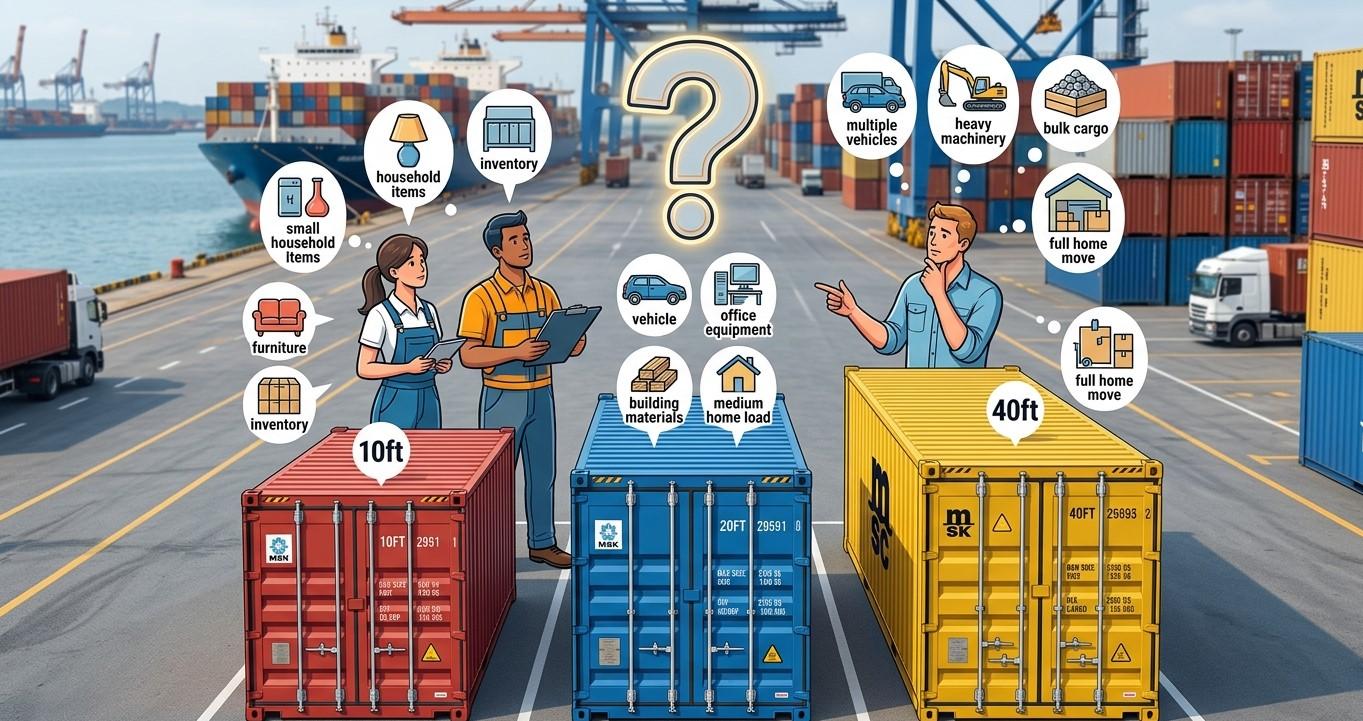
Choosing the right shipping container size can make a big difference in how much you spend, how easily you can organize your belongings, and how well the container fits your property. Whether you need secure storage, equipment space, inventory storage, or a customized workspace, selecting the right size is an important first step.
The most common options include 10ft, 20ft, and 40ft shipping containers, with 40ft high-cube containers providing additional vertical space. The best choice depends on what you plan to store, how much space you have available, and how frequently you need access to your items.
If you are searching for shipping containers for sale, this guide will help you understand the differences between common sizes and choose the right container for your needs.
Table of Contents
- What Shipping Container Sizes Are Available?
- 10ft Shipping Containers
- 20ft Shipping Containers
- 40ft Shipping Containers
- 40ft High-Cube Containers
- 10ft vs. 20ft vs. 40ft: Which Should You Choose?
- What to Consider Before Choosing a Container Size
- Frequently Asked Questions
- Find the Right Shipping Container With Conex Hub
What Shipping Container Sizes Are Available?
Shipping containers come in several sizes, but 10ft, 20ft, and 40ft containers are among the most useful options for storage, commercial applications, and customized projects.
Standard containers are generally 8 feet wide and 8 feet 6 inches tall externally. A standard 20ft container provides approximately 1,170 cubic feet of internal volume, while a standard 40ft container provides approximately 2,390 cubic feet. Exact dimensions and capacities can vary depending on the specific container.
| Container Size | Approx. Exterior Dimensions | Best For |
|---|---|---|
| 10ft | 10' × 8' × 8'6" | Small storage, tools, equipment, tight spaces |
| 20ft | 20' × 8' × 8'6" | General storage, jobsites, equipment, inventory |
| 40ft | 40' × 8' × 8'6" | Large inventory, commercial storage, bulk materials |
| 40ft High Cube | 40' × 8' × 9'6" | Tall equipment, racking, modifications, larger projects |
Remember that these are approximate dimensions. Before purchasing, verify the specifications of the exact unit you are considering.
10ft Shipping Containers
A 10ft shipping container is a good choice when you need secure storage but have limited space.
Because it takes up less room than a 20ft or 40ft container, a 10ft unit can work well for residential properties, smaller businesses, construction sites, maintenance teams, and locations where available space is limited.
Common uses for 10ft containers include:
- Tools and equipment
- Landscaping supplies
- Seasonal items
- Construction materials
- Small business inventory
- Maintenance supplies
- Event equipment
The main advantage is its compact footprint. However, if you expect your storage needs to grow or need room for shelving and frequent movement inside the container, a 20ft unit may be a better long-term choice.
20ft Shipping Containers
For many buyers, the 20ft shipping container is the most versatile option.
A standard 20ft container is approximately 20 feet long, 8 feet wide, and 8 feet 6 inches high externally. Its internal dimensions are smaller because of the container walls and structural components.
A 20ft container provides a useful balance between capacity and footprint, making it popular for both commercial and personal storage.
A 20ft container may be ideal for:
- Construction equipment
- Tools and machinery
- Business inventory
- Agricultural supplies
- Household storage
- Jobsite materials
- Small workshops
- Equipment storage
If you're unsure whether you need a 10ft or 20ft container, consider not only what you own today but also what you may need to store in the future.
Conex Hub offers 20ft shipping containers for sale in different conditions and configurations, giving buyers options based on their intended use and budget.
40ft Shipping Containers
When you need significantly more storage capacity, a 40ft shipping container can be the better choice.
A standard 40ft container is approximately twice the length of a 20ft container and provides roughly 2,390 cubic feet of internal volume.
40ft containers are commonly used for:
- Large business inventory
- Construction materials
- Manufacturing supplies
- Agricultural equipment
- Commercial storage
- Large equipment
- Bulk materials
- Long-term storage
The additional floor space can also make organization easier. Instead of stacking everything tightly, you may have more room for shelving, aisles, equipment, or separate storage zones.
However, a 40ft container requires more room for delivery and placement. Before ordering one, make sure your property can accommodate both the container and the delivery equipment.
40ft High-Cube Containers
Need additional vertical clearance? A 40ft high-cube shipping container may be the right option.
High-cube containers are approximately one foot taller than standard containers, providing additional interior height. This can be particularly useful for tall equipment, vertical storage, shelving, and container modification projects.
A 40ft high cube can be especially useful when you're planning to convert a container into an office, workshop, retail space, or another customized structure.
10ft vs. 20ft vs. 40ft: Which Should You Choose?
The right container depends primarily on your storage requirements and available space.
Choose a 10ft container if:
- You have limited property space.
- You only need moderate storage.
- You're storing tools, equipment, or seasonal items.
- You want a smaller footprint.
Choose a 20ft container if:
- You need versatile general-purpose storage.
- You have equipment, materials, or inventory to store.
- You want a balance between capacity and footprint.
- You expect your storage needs to grow.
Choose a 40ft container if:
- You need substantial storage capacity.
- You're storing large amounts of inventory or materials.
- You need additional floor space.
- You have sufficient room for delivery and placement.
Choose a 40ft high cube if:
- You need additional vertical clearance.
- You plan to install tall shelving.
- You're storing tall equipment.
- You're planning a container modification or conversion.
What to Consider Before Choosing a Container Size
Size isn't the only factor to consider when buying a container. Before ordering, think about these important considerations.
1. Measure Your Items
Measure the longest, widest, and tallest items you intend to store. Don't forget to account for pallets, shelving, packaging, and the space needed to move around inside the container.
2. Consider Future Storage Needs
Buying a container that barely meets today's needs could leave you searching for additional storage sooner than expected. If you anticipate business growth or additional equipment, choosing a slightly larger container may be more practical.
3. Check Your Available Space
Measure the area where the container will be placed. Also consider access for the delivery truck and the equipment used to position the container.
4. Think About Access
If you'll need to access items frequently, simply choosing the largest container isn't always the answer. Organization, shelving, doors, and aisle space can be just as important as total capacity.
5. Consider the Container's Height
For certain applications, a high-cube container may provide considerably more practical space than a standard-height unit.
6. Consider Delivery
Before buying, confirm that the delivery location has adequate access and space for placement. A container that fits your storage requirements still needs to physically reach its intended location.
Frequently Asked Questions
What is the most popular shipping container size?
The 20ft container is a popular general-purpose choice because it provides substantial storage while requiring less space than a 40ft container.
Is a 10ft container big enough for storage?
A 10ft container can be an excellent option for tools, equipment, seasonal belongings, and smaller inventories. However, larger households or businesses may benefit from a 20ft or 40ft container.
Is a 40ft container twice the size of a 20ft container?
A 40ft container is approximately twice as long as a 20ft container and provides substantially more floor area and internal volume. Exact usable capacity depends on the specific container and how it is configured.
What is the difference between a standard and high-cube container?
The primary difference is height. A standard container is approximately 8 feet 6 inches high externally, while a high-cube container is approximately 9 feet 6 inches high, providing additional vertical space.
How do I find a shipping container for sale near me?
Start by looking for a reputable container supplier that serves your area and offers delivery. When comparing shipping container for sale near me options, consider container condition, size, delivery requirements, customization options, and the supplier's reputation—not just the advertised price.
Are storage containers and shipping containers the same?
They can be similar, but the terminology often reflects the intended use. Many shipping containers are also used for secure on-site storage. If your primary goal is storage, compare available storage containers for sale based on size, condition, doors, security, and delivery.
Find the Right Shipping Container With Conex Hub
Choosing the right container doesn't have to be complicated. Start by determining what you need to store, how much space you have available, and how frequently you'll need access to the contents.
Whether you need a compact 10ft unit, a versatile 20ft container, or a spacious 40ft high-cube container, Conex Hub can help you find a container suited to your project.
If you're comparing shipping containers for sale, looking for storage containers for sale, or searching for a shipping container for sale near me, explore the available options and request a quote from Conex Hub.
Ready to choose the right container? Contact Conex Hub today to discuss your size, delivery, and storage requirements and find the container that fits your project.

 English
 Arabic
 French
 Spanish
 Portuguese
 Deutsch
 Turkish
 Dutch
Dutch
 Russian
 Romaian
 Portuguese (Brazil)
 Greek
Greek