


Network Installation Services: Build a Network That Lasts
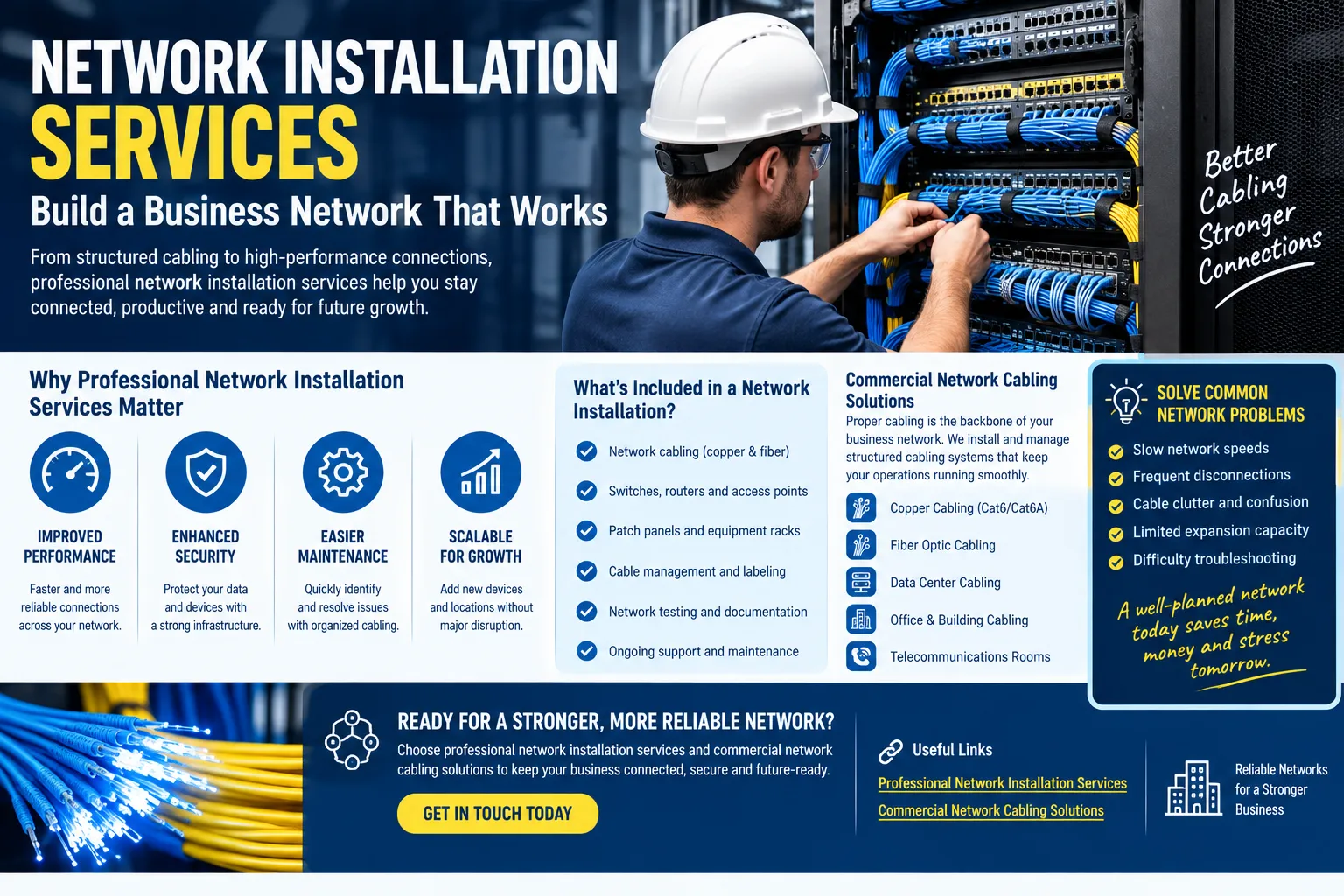
A business network can work perfectly one day and become a source of frustration the next. Employees may experience dropped connections, slow file transfers, unreliable Wi-Fi, or interruptions during important video calls. While network equipment is often blamed first, the underlying cabling infrastructure can be just as important.
Routers, switches, access points, computers, phones, and servers all depend on physical connections to communicate properly. If those connections are poorly planned, damaged, outdated, or difficult to maintain, network performance can suffer.
Professional network installation services provide a structured way to design, install, test, and organize the infrastructure that supports business communications. Instead of treating each connectivity issue as an isolated problem, a well-planned installation addresses the network as a complete system.
Why Business Networks Develop Connectivity Problems
Network issues can appear for many reasons. A company may have old cabling that was installed before its current technology was introduced. Another business may have added new devices over time without updating the original infrastructure.
Common problems include:
- Unstable network connections
- Slow internal data transfers
- Poor wireless performance
- Damaged or improperly terminated cables
- Overcrowded network racks
- Unlabeled connections
- Insufficient network outlets
- Cable routes that are difficult to access
- Outdated infrastructure
- Difficulty adding new devices
These problems can become more serious as the business grows. Adding computers, phones, security cameras, wireless access points, and other connected equipment increases the demands placed on the network.
A professional assessment can help determine whether the problem is related to cabling, equipment, configuration, or another part of the infrastructure.
What Does a Network Installation Include?
A complete network installation involves much more than running cables from one location to another.
Depending on the project, the work may include network planning, cable selection, pathway design, equipment placement, structured cabling, termination, patch panel installation, rack organization, labeling, testing, and documentation.
The installation should begin with an understanding of how the business uses its network.
For example, an office with dozens of employees may require connections for computers, VoIP phones, printers, wireless access points, and conference room equipment. A warehouse may have different requirements involving wireless coverage, cameras, scanners, and other connected devices.
The infrastructure should reflect these specific needs rather than relying on a one-size-fits-all design.
How to Choose the Right Cabling Company
Choosing a cabling company is an important decision because the physical infrastructure can remain in place for many years.
Before hiring a provider, businesses should consider several factors.
Experience With Commercial Networks
Commercial installations can be more complex than residential projects. Look for a provider familiar with business environments, structured cabling, network rooms, and larger-scale installations.
Clear Project Planning
A professional provider should be able to explain what will be installed, where cables will run, what equipment is required, and how the completed system will be tested.
Proper Cable Selection
Different network applications can have different requirements. The cable category, bandwidth capabilities, distance, and installation environment should all be considered.
Testing and Documentation
A quality installation should include appropriate testing and clear documentation. This makes it easier to troubleshoot and maintain the infrastructure later.
Future Scalability
A network should have reasonable capacity for expected growth. Businesses should not have to redesign their entire cabling system every time they add several new devices.
Cabling Contractor vs. General IT Support
A cabling contractor focuses on the physical infrastructure that connects network and communications equipment. This can include cable installation, termination, pathways, racks, patch panels, labeling, and testing.
General IT support may focus more heavily on computers, software, network configuration, cybersecurity, cloud systems, and user support.
The two areas can complement each other, but they solve different types of problems.
If employees are experiencing connection issues, for example, an IT professional may investigate network configuration while a cabling contractor evaluates the physical connections. Identifying the correct source of the problem can prevent a business from spending money on unnecessary equipment replacements.
Why Structured Cabling Makes Maintenance Easier
A disorganized network can make even a simple repair unnecessarily difficult.
Imagine a network rack containing dozens of cables with no labels and inconsistent routing. If one workstation loses connectivity, a technician may need to trace multiple cables to find the correct connection.
Structured cabling creates a more predictable layout. Patch panels, labeled ports, organized cable management, and documented connections make the infrastructure easier to understand.
This can reduce troubleshooting time and help technicians work more efficiently when equipment needs to be replaced or upgraded.
Cable Management Is More Than Appearance
Tangled cables do not merely make a network room look untidy. They can create practical maintenance problems.
Crowded cable bundles can make it difficult to access equipment and identify individual connections. They may also complicate future upgrades.
Good cable management keeps connections organized and provides appropriate separation and routing. It also makes it easier to identify unused, active, and critical connections.
A clean installation gives technicians a clearer view of the infrastructure and reduces the risk of accidentally disturbing unrelated connections during maintenance.
Copper and Fiber Can Serve Different Purposes
A business network does not necessarily need the same cable technology everywhere.
Copper Ethernet cabling can be suitable for many shorter connections to computers, phones, printers, cameras, and wireless access points.
Fiber optic infrastructure can be useful for longer-distance or high-capacity connections, such as links between network closets, floors, buildings, or other locations.
Using a combination of technologies can allow businesses to match the infrastructure to each application.
The right choice depends on distance, bandwidth requirements, network equipment, installation conditions, and future needs.
Planning Network Installation for Business Growth
One of the biggest mistakes businesses make is designing a network only for their current number of devices.
A company with 25 employees today may have 50 or more in the future. It may also add additional offices, surveillance cameras, wireless access points, servers, or cloud-based systems.
A scalable installation should account for reasonable future requirements without creating unnecessary expense.
This can involve installing sufficient outlets, planning accessible pathways, leaving appropriate rack capacity, and selecting infrastructure that can accommodate expected technology upgrades.
Planning ahead can reduce the need for disruptive cabling work later.
Why Testing Should Never Be Skipped
A cable can look perfectly installed and still have a performance problem.
Testing helps identify issues such as incorrect termination, damaged conductors, excessive signal loss, or other faults. Detecting these problems immediately is much better than discovering them after employees depend on the network.
Testing also provides useful information for future maintenance. When installation records and test results are available, technicians have a clearer picture of the network's original condition.
When Should You Consider Professional Installation?
Businesses should consider professional network installation when moving into a new facility, remodeling an office, expanding operations, replacing outdated infrastructure, or experiencing recurring connectivity problems.
Professional installation may also be worthwhile when the existing network has become difficult to document or maintain.
Instead of repeatedly addressing individual connection failures, a complete infrastructure assessment can reveal whether the underlying cabling system needs improvement.
Businesses planning an upgrade can explore professional network cabling installation services to evaluate their current infrastructure and develop a practical installation strategy.
Common Mistakes to Avoid
Several cabling mistakes can create unnecessary problems later.
Installing Cables Without a Plan
Unplanned cable routes can create clutter and make future maintenance difficult.
Choosing Cable Based Only on Price
The cheapest option may not provide the performance or longevity required for the application.
Ignoring Labeling
Unlabeled connections increase troubleshooting time and make future changes more complicated.
Overlooking Future Expansion
A network designed with no consideration for growth can quickly become restrictive.
Skipping Testing
Without proper testing, hidden installation problems may remain unnoticed until they affect users.
Final Thoughts
A reliable business network starts with a physical infrastructure that is designed around the organization's needs. Professional network installation services can help businesses address connectivity problems while creating a cleaner, more maintainable foundation for future technology.
Whether the project involves a new office, an infrastructure upgrade, additional network devices, or a complete cabling redesign, choosing an experienced cabling company and qualified cabling contractor can make the process more predictable.
The best installation is not simply one that connects today's devices. It should also make troubleshooting easier, support reasonable business growth, and provide a clear infrastructure that technicians can understand years after the original project is completed.

 English
 Arabic
 French
 Spanish
 Portuguese
 Deutsch
 Turkish
 Dutch
Dutch
 Italiano
 Russian
 Portuguese (Brazil)
 Greek
Greek