


Not Clothes—Textiles: 5 B2B Markets That Could Need Commercial Washing and Drying
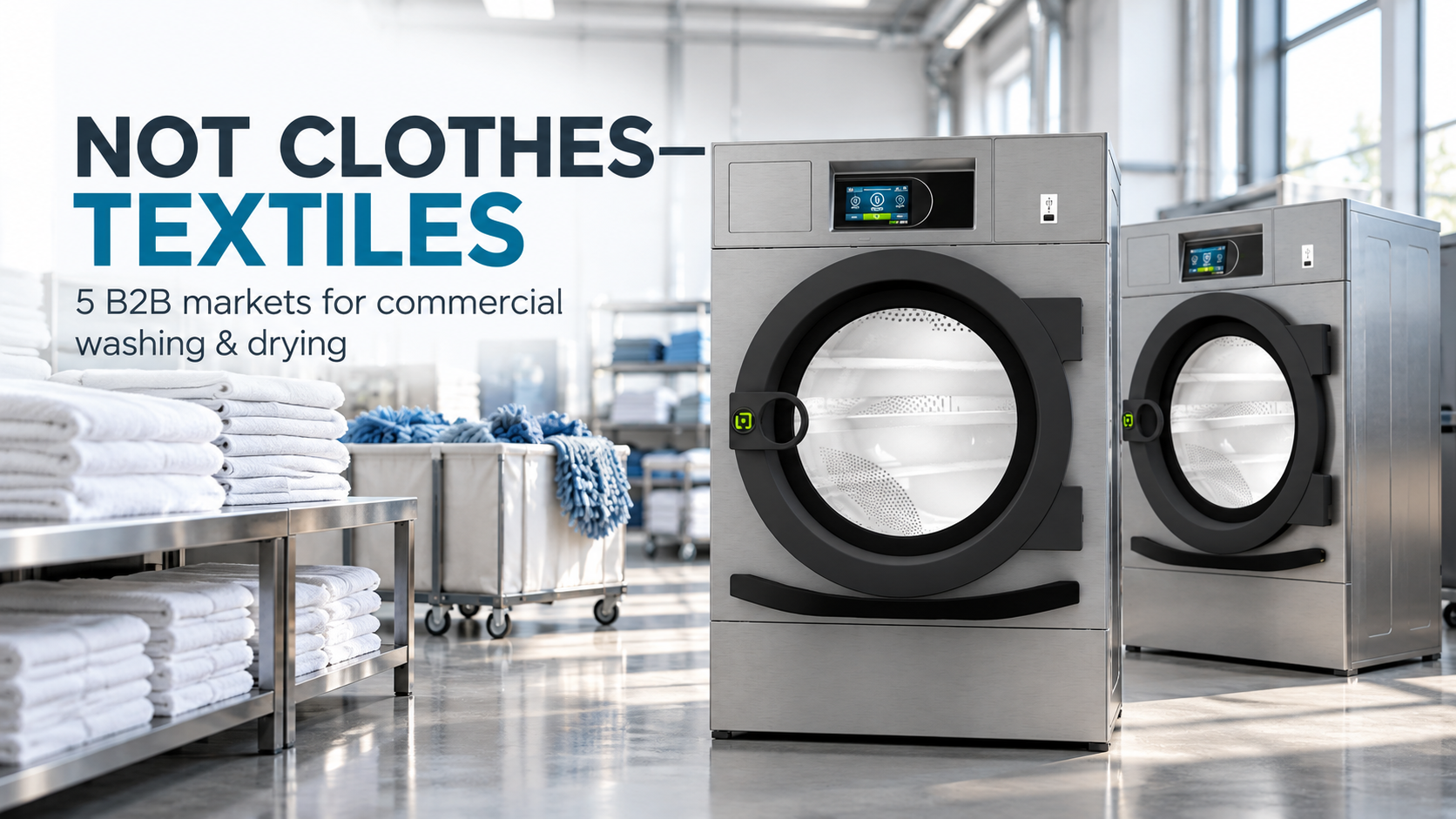
When most people think about starting a laundry business, they imagine shirts, trousers, bedsheets, and household clothes. But many commercial businesses repeatedly use towels, microfiber cloths, linen, covers, and other washable textiles as part of their daily operations.
That creates a different opportunity for entrepreneurs: instead of competing for individual household customers, build a B2B laundry business around recurring textile-processing requirements. The key is to identify the right market, understand its textile volume, and then select suitable washing equipment and an industrial tumble dryer around real demand.
Why Look Beyond Clothes When Starting a B2B Laundry Business?
A traditional laundry usually depends on individual customers bringing mixed garments in different quantities. A B2B textile-processing business can work differently.
Instead of asking:
“Who needs clothes washed?”
ask:
“Which businesses repeatedly use washable textiles?”
That change in thinking can reveal markets with recurring operational loads.
Examples may include towels, microfiber cloths, table linen, reusable cleaning textiles, bedding, and other suitable items. These are not necessarily customer garments, but they still need to move through a regular cleaning cycle.
The business model can look like:
Business Client → Used Textiles → Scheduled Collection → Washing → Drying → Inspection → Packing → Return
For a first-time entrepreneur, this can create a more focused route to market. Rather than trying to serve everybody, you can choose one or two industries, learn their textile requirements, and build a commercial laundry setup around those needs.
The important point is to validate actual recurring volume before investing.
5 B2B Markets That Could Need Commercial Washing and Drying
1. Car Detailing and Automotive Care Businesses
Car detailing businesses often use reusable microfiber towels and similar cleaning textiles during polishing, drying, interior cleaning, and detailing work.
Instead of each detailing centre managing its own textile washing, an entrepreneur could investigate whether local operators would use a scheduled processing service.
A potential workflow could be:
Detailing Centre → Used Microfiber → Collection → Sorting → Washing → Suitable Drying → Return
Microfiber requires appropriate care, so washing chemistry, temperature, and drying conditions should follow the textile supplier's recommendations.
The opportunity is not based on one detailing shop. It comes from asking whether several businesses in one area could generate enough recurring loads to justify professional commercial washing and drying equipment.
2. Event Linen and Party Rental Companies
Event companies, caterers, and linen-rental businesses may repeatedly circulate items such as:
-
Tablecloths
-
Napkins
-
Suitable chair covers
-
Decorative linen
-
Other reusable event textiles
For these businesses, turnaround can matter as much as cleaning.
An item used at one event may need to be processed and prepared before the next booking. That means washing capacity alone may not determine how much work can be handled.
The complete process is:
Returned Linen → Sorting → Washing → Extraction → Drying → Finishing → Packing → Next Event
This makes the commercial laundry dryer an important part of capacity planning.
3. Pet Grooming, Boarding, and Pet-Care Businesses
Pet-care businesses can use towels, bedding, blankets, and other washable textiles depending on the service they provide.
An entrepreneur could investigate whether grooming centres, boarding facilities, and similar businesses prefer to process these items internally or outsource suitable loads.
This niche requires careful process planning.
Textiles may have different soil conditions and hygiene requirements, so segregation, care instructions, and the appropriate washing process should be established before processing.
The business opportunity lies in solving a repeated operational requirement:
Used Textiles → Processing → Clean Stock Returned to Business
Rather than finding hundreds of pet owners, the laundry serves a smaller number of business clients.
4. Caterers and Food-Service Linen Operators
Catering companies and food-service operations can generate recurring textile loads such as table linen, napkins, and suitable reusable service cloths.
Food-related soils can make sorting and process selection particularly important.
A professional workflow could include:
Receive → Sort by Textile and Soil Type → Wash → Extract → Dry Where Suitable → Finish → QC → Return
A business serving this market would need to understand daily and peak-event volumes before choosing industrial laundry equipment.
Large events can also create uneven demand. A normal weekday may generate relatively little work, while weekends or wedding seasons may produce significantly higher loads.
This is why equipment planning should account for peaks, not just monthly averages.
5. Wellness and Treatment Centres
Massage centres, therapy facilities, spas, wellness clinics, and similar businesses may use towels, sheets, and other reusable textiles depending on the services they offer.
Smaller operators may not want to dedicate significant space or staff time to internal laundry processing.
That creates a question worth researching:
Could several wellness businesses within one delivery route support a recurring textile-processing service?
The entrepreneur could potentially provide:
Scheduled Collection → Central Processing → Drying → Folding/Packing → Scheduled Return
The actual process should always be designed around the textile type, care instructions, and client requirements.
Why Can an Industrial Tumble Dryer Become the Real Capacity Bottleneck?
New laundry entrepreneurs often start by calculating how much they can wash.
But the entire operation only moves as fast as its slowest stage.
Consider this:
Washer Finished → Dryer Still Running → Wet Load Waits → Next Loads Queue
If this keeps happening, adding more washing capacity will not automatically increase output.
A better capacity sequence is:
Washing Capacity → Extraction → Drying Capacity → Finishing → Packing → Dispatch
When planning an industrial tumble dryer, consider:
-
Daily textile KG
-
Practical load size
-
Number of loads
-
Moisture remaining after extraction
-
Textile type
-
Required drying condition
-
Available working hours
-
Heating configuration
-
Airflow and exhaust requirements
-
Machine specifications
A dryer rated at the same KG as a washer does not automatically mean both machines will provide perfectly balanced throughput.
Different textiles behave differently during drying.
A load of lightweight cloths may have a different drying requirement from towels or heavier linen.
The better principle is:
Your processing capacity is determined by where work starts waiting—not by the biggest machine in the room.
How Should You Choose Commercial Washing and Drying Equipment?
Do not begin with a machine catalogue.
Begin with your target market.
The planning sequence should be:
Target Industry → Textile Type → Number of Clients → Daily KG → Peak KG → Practical Loads → Turnaround Requirement → Washing Capacity → Drying Capacity
Then compare commercial laundry equipment against the actual workflow.
For an industrial dryer, evaluate factors such as:
-
Rated capacity
-
Drum volume
-
Heating system
-
Controls
-
Utility requirements
-
Exhaust and ventilation requirements
-
Installation dimensions
-
Available operating hours
-
Textile compatibility
-
Service support
Likewise, the washing stage should be designed around the same customer volume and textile requirements.
Do not assume:
20 KG Washer + 20 KG Dryer = Automatically Balanced Setup
The real relationship depends on extraction, textile mix, loading practices, drying requirements, and cycle times.
How Do You Know Which B2B Textile Market Is Worth Entering?
Before buying an industrial dryer machine, validate the market first.
Map potential customers within the area you can realistically serve.
For example:
Automotive Detailers → Event Companies → Pet-Care Businesses → Caterers → Wellness Centres
Then speak to them.
Ask:
-
What textiles do you use regularly?
-
How much do you process each week?
-
How are they currently washed and dried?
-
Do you outsource any processing?
-
What turnaround do you need?
-
Is demand steady or seasonal?
-
Would scheduled collection and delivery help?
Once you have realistic numbers, calculate:
Expected Daily KG = Active Clients × Average Daily KG per Client
Then estimate:
Required Loads Per Day = Expected Daily KG ÷ Practical Average Load
This creates a much stronger foundation for an industrial laundry business than purchasing equipment first and searching for customers later.
How Orgaearth Can Help You
Orgaearth can help entrepreneurs evaluate washing and drying equipment according to the actual B2B market they want to serve.
Planning an industrial tumble dryer can begin with:
Textile Type + Expected Daily KG + Practical Loads + Moisture After Extraction + Operating Hours + Utilities + Space
From there, suitable commercial tumble dryers, washer extractors, and supporting laundry processing equipment can be evaluated according to the intended application.
The goal is to create balanced capacity across washing, drying, finishing, and dispatch instead of selecting individual machines in isolation.
Frequently Asked Questions
What is an industrial tumble dryer used for?
An industrial tumble dryer is used to provide controlled drying capacity in commercial and industrial laundry operations. The suitable machine depends on textile type, expected volume, utilities, and processing requirements.
Can I start a B2B laundry without washing customer clothes?
Yes. A business can potentially focus on reusable commercial textiles rather than individual household garments, provided there is enough recurring demand from business clients.
Which businesses may need commercial washing and drying services?
Potential markets include automotive detailing businesses, event-linen operators, pet-care businesses, caterers, wellness centres, and other organizations that regularly use washable textiles.
What size industrial tumble dryer does a new laundry need?
There is no universal size. Calculate expected daily KG, textile mix, practical load size, drying cycles, operating hours, and peak demand before selecting capacity.
Can a commercial tumble dryer process microfiber towels?
Suitable microfiber textiles may be dried mechanically, but the correct conditions should follow the textile manufacturer's care recommendations. Excessive or unsuitable heat may not be appropriate for every microfiber product.
Should washer and dryer capacity always be the same?
Not necessarily. Matching rated KG alone does not guarantee balanced processing. Extraction performance, textile type, practical loads, cycle times, and required drying conditions should also be considered.
Conclusion
A commercial laundry business does not have to be built around household clothing. Businesses across automotive care, events, pet care, catering, and wellness may generate recurring textile loads that create potential B2B processing opportunities.
The smarter path is:
Find the Textile Market → Validate Recurring Volume → Understand Processing Requirements → Plan Washing Capacity → Calculate Drying Capacity → Select Industrial Tumble Dryer
Build around the recurring customer problem first. Let the equipment follow the business requirement.
Contact Us:
Orgaearth Laundry Solutions
Plot no. 774, Udyog Vihar, Phase 5, Gurugram, Haryana, India-122016
Email: marketing@orgaearth.com
Contact No.- +91 7042912777

 English
 Arabic
 French
 Portuguese
 Deutsch
 Turkish
 Dutch
 Italiano
 Russian
 Romaian
 Portuguese (Brazil)
 Greek