


The Role of Docbyte Vault in Modern Enterprise Information Governance
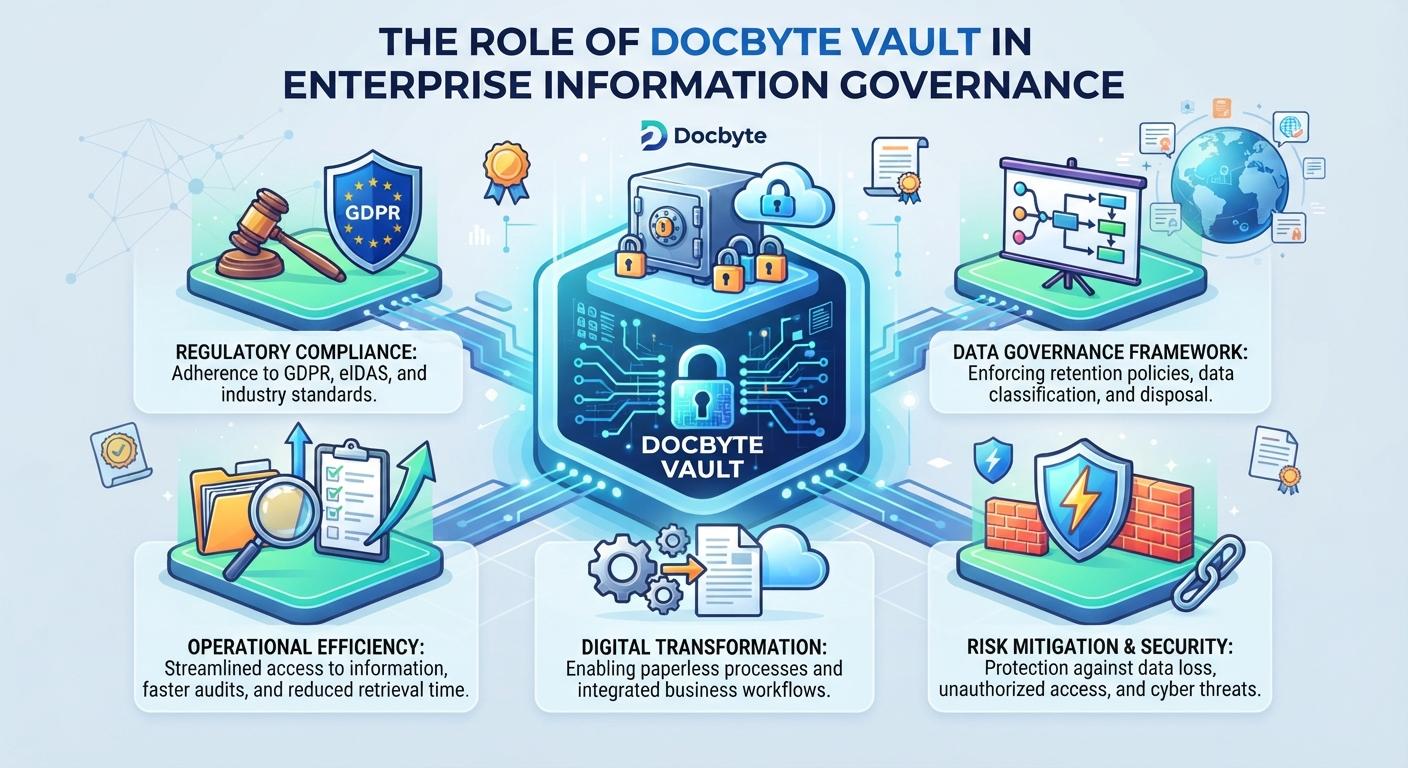
Modern enterprises generate and manage enormous amounts of digital information every day. Contracts, customer records, financial documents, employee files, compliance records, digital signatures, and operational data all contribute to an organization’s growing information landscape. However, as data volumes increase and business systems continue to change, managing information effectively becomes more complex. Organizations must ensure that important records remain secure, accessible, authentic, and properly governed throughout their entire lifecycle. Simply storing documents is no longer enough. Businesses need a structured approach that protects information from creation through retention and eventual disposal. Docbyte Vault supports modern enterprise information governance by providing a controlled environment for digital records management, preservation, and long-term information protection. It helps organizations maintain trust in their records by preserving context, metadata, integrity, accessibility, and compliance requirements while reducing dependency on outdated systems.
Information Governance Has Become a Business Priority
Information governance has evolved significantly as organizations have moved from paper-based processes to fully digital environments.
In the past, managing records often meant organizing physical files, maintaining storage rooms, and following manual retention procedures.
Today, organizations manage information across:
- cloud platforms
- enterprise applications
- document management systems
- customer relationship systems
- collaboration tools
- electronic signature platforms
- legacy applications
This creates a much more complex environment where information can become fragmented across different systems.
Without proper governance, organizations may experience:
- duplicate records
- inconsistent data management
- unclear ownership
- security risks
- compliance challenges
- difficulty retrieving historical information
Modern information governance ensures organizations know what information they have, where it exists, how it should be protected, and how long it should remain available.
Storage Alone Cannot Solve Enterprise Information Challenges
Many organizations still approach information management primarily as a storage problem.
They focus on:
- increasing storage capacity
- creating backups
- maintaining availability
- reducing infrastructure costs
While storage is important, it does not answer critical governance questions.
Organizations also need to know:
- Is this the official record?
- Has the information changed?
- Who created it?
- What business process produced it?
- Who is allowed to access it?
- How long should it be retained?
- Can its history be demonstrated?
A document stored for many years may still exist, but without context and control, its value can decline.
Docbyte Vault focuses on managing information as a trusted business asset rather than treating records as simple files.
Docbyte Vault Creates a Controlled Digital Records Environment
Enterprise information does not remain inside active systems forever.
Business applications are designed for daily operations. Employees create documents, process transactions, approve information, and complete workflows.
However, once information becomes a record, different requirements apply.
A completed contract may no longer require editing but may need to remain available for legal review. A financial document may no longer support daily operations but may still require long-term retention.
Docbyte Vault provides an environment where organizations can preserve records after active use while maintaining governance requirements.
This allows businesses to separate important records from operational systems without losing access or control.
Metadata Preserves Information Context
One of the biggest challenges in long-term information management is maintaining context.
A file by itself often does not provide enough information.
For example, a document named:
"agreement_final.pdf"
does not explain:
- who created it
- which customer it belongs to
- when it was approved
- whether it is the official version
- which retention policy applies
Metadata provides this essential context.
Important metadata may include:
- document classification
- source system
- creation date
- business owner
- customer reference
- transaction information
- approval history
- retention category
Docbyte Vault supports metadata-driven records management, helping organizations preserve the meaning of information even when business systems, employees, and processes change.
Digital Records Require Long-Term Preservation
Modern businesses create records that may need to remain available for many years.
Examples include:
- legal agreements
- financial documents
- regulatory records
- customer information
- intellectual property
- signed contracts
The challenge is that technology changes faster than record retention periods.
Applications become outdated. File formats evolve. Storage platforms are replaced.
Without preservation strategies, records can become difficult to access even when they still exist.
Docbyte Vault supports long-term information preservation by helping organizations maintain records independently from changing technology environments.
Application Retirement Becomes Easier With Controlled Archiving
Legacy applications create significant challenges for enterprises.
Many organizations continue maintaining outdated systems because important historical records remain inside them.
These applications may contain:
- customer history
- transaction data
- contracts
- approval workflows
- compliance information
Keeping them active creates technical debt, security risks, and operational costs.
Docbyte Vault helps organizations separate records from legacy applications.
Instead of preserving the outdated technology, businesses can preserve the valuable information.
This allows organizations to retire applications while maintaining access to historical records.
Retention Management Supports Compliance Requirements
Information governance requires clear retention strategies.
Organizations must understand:
- what records should be kept
- how long they should remain available
- when they can be disposed of
- which records require additional protection
Poor retention management creates two major risks:
- Important records are deleted too early.
- Unnecessary information is stored indefinitely.
Both situations can create compliance and security issues.
Docbyte Vault supports controlled retention management by allowing organizations to apply lifecycle rules to records based on business requirements and governance policies.
This creates a more consistent approach to managing information over time.
Digital Signatures Need Trusted Preservation
Electronic signatures have become an important part of modern business transactions.
Organizations use digital signatures for:
- contracts
- approvals
- agreements
- compliance documents
However, preserving a signed document requires more than storing the final file.
Long-term trust may depend on:
- digital certificates
- timestamps
- validation information
- signer identity
- integrity evidence
These elements can become difficult to verify as technology changes.
Docbyte Vault supports long-term preservation scenarios where organizations need to maintain trust in electronically signed records beyond the original signing environment.
Integrity Protection Maintains Record Reliability
Enterprise records often move through different systems during their lifecycle.
Organizations may:
- migrate platforms
- consolidate repositories
- replace applications
- modernize infrastructure
During these changes, maintaining record reliability is essential.
Organizations need confidence that:
- information was transferred correctly
- records were not altered improperly
- metadata remained connected
- lifecycle history was preserved
Docbyte Vault supports controlled records management processes that help maintain information integrity throughout technology changes.
Secure Access Protects Sensitive Information
Enterprise archives often contain highly sensitive information.
Examples include:
- customer data
- employee records
- financial information
- confidential agreements
- intellectual property
Information governance requires a balance between accessibility and security.
Authorized users need access when required, but unnecessary exposure must be prevented.
Docbyte Vault supports controlled access by helping organizations manage permissions, protect sensitive records, and maintain visibility into information usage.
Audit Trails Improve Governance Transparency
Organizations need to understand how records have been managed.
During audits or investigations, businesses may need to demonstrate:
- when records were created
- when they entered preservation
- who accessed them
- whether changes occurred
- how retention decisions were applied
Audit trails provide visibility into record history.
Docbyte Vault supports governance processes by maintaining information about important lifecycle activities.
This helps organizations demonstrate control and accountability.
Search and Retrieval Keep Information Valuable
An archive is only useful if organizations can find information when needed.
As businesses grow, records become distributed across many systems and departments.
Without structured retrieval capabilities, employees may waste significant time searching for historical information.
Docbyte Vault supports organized access through:
- metadata-based search
- record classification
- structured information retrieval
- controlled access workflows
This allows authorized users to locate important records without depending on outdated systems.
Information Governance Supports Business Transformation
Modern organizations constantly change.
They adopt new technologies, restructure teams, merge with other companies, and redesign workflows.
Every change creates information management challenges.
Without proper governance:
- records can become fragmented
- important information can be lost
- legacy systems remain active unnecessarily
- compliance risks increase
Docbyte Vault provides continuity by allowing records to remain governed while the organization evolves.
The business can modernize its technology while protecting its digital history.
Artificial Intelligence Depends on Reliable Information
Organizations are increasingly adopting artificial intelligence for analysis, automation, and decision-making.
However, AI systems depend on reliable information.
Poorly managed records can create problems because they may lack:
- accurate context
- proper classification
- consistent structure
- reliable history
Digital records governance creates stronger foundations for future AI initiatives.
By preserving trusted information, organizations improve their ability to use historical data effectively.
The Future of Enterprise Information Governance
Information volumes will continue increasing.
Organizations will create more digital records across more systems, making governance increasingly important.
Future-ready information governance requires capabilities such as:
- digital preservation
- lifecycle management
- retention control
- application independence
- secure access
- audit readiness
Docbyte Vault supports this future by helping organizations manage information as a long-term business asset.
The focus shifts from storing more data to maintaining trusted information.
Conclusion
Modern enterprise information governance requires more than storing digital files. Organizations need a structured approach that protects records, maintains context, supports compliance, and ensures long-term accessibility.
Docbyte Vault helps organizations create a controlled environment for managing digital records throughout their lifecycle. By supporting metadata preservation, retention management, integrity protection, secure access, audit visibility, and long-term preservation, it allows businesses to maintain confidence in their information.
As organizations continue transforming their technology environments, the ability to preserve reliable digital records independently from changing systems will become essential. Docbyte Vault helps enterprises protect their digital knowledge, reduce information risks, and build a stronger foundation for future business operations.

 English
 Arabic
 French
 Spanish
 Portuguese
 Deutsch
 Turkish
 Dutch
Dutch
 Russian
 Romaian
 Portuguese (Brazil)
 Greek
Greek