


Why Do AI Search Engines Recommend Certain Brands Over Others?
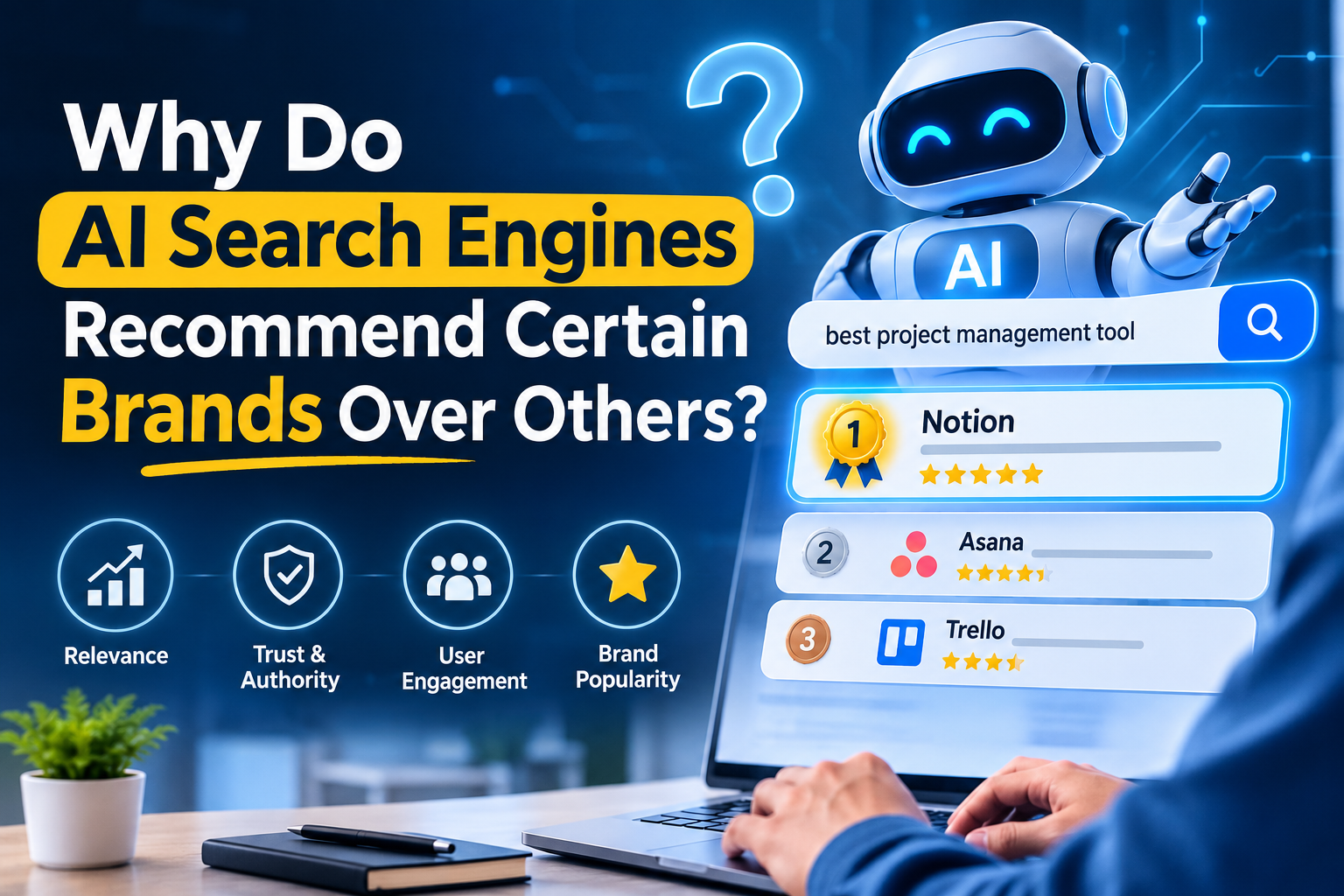
The way people search for information online is changing. Traditional search engines display a list of webpages based on relevance, authority, and other ranking signals. AI search engines take a different approach by analyzing information from multiple sources and generating direct answers that often include recommended brands, products, and services.
Platforms such as ChatGPT, Google AI Overviews, Perplexity, and Microsoft Copilot are changing how consumers discover businesses. Instead of browsing several websites, users can ask questions and receive summarized recommendations. This creates new opportunities for businesses to increase their visibility and attract potential customers.
However, not every brand receives the same attention. Some businesses appear frequently in AI generated answers, while others remain largely invisible. Understanding why AI search engines recommend certain brands over others can help businesses develop stronger digital marketing strategies and improve their online presence.
How AI Search Engines Select Brands
AI search engines use advanced language models and information retrieval systems to understand user questions and identify relevant information. Depending on the platform and query, they may analyze website content, indexed webpages, structured information, reviews, and other available sources.
Their goal is to provide useful answers that match the user's search intent.
For example, someone searching for a reliable digital marketing agency may receive recommendations based on information about agency services, industry experience, customer feedback, and online reputation.
A brand with clear, consistent, and relevant information across different platforms may have a better opportunity to appear in these recommendations.
Brand Authority Builds Trust
Brand authority is an important factor in establishing online credibility. AI search engines can identify brands that have a meaningful presence across relevant websites and information sources.
Businesses that consistently publish useful content, receive genuine industry mentions, and demonstrate expertise can build stronger digital authority.
For example, a company that contributes informative articles to respected industry publications may create additional opportunities for search engines to recognize its expertise.
However, simply collecting backlinks or publishing content on unrelated websites does not guarantee AI visibility. The relevance, quality, and credibility of information are more important than the number of online mentions.
Building authority requires consistent efforts across content marketing, public relations, and search engine optimization.
Content Quality Influences AI Recommendations
High quality content helps AI systems understand what a business offers and which audience it serves.
Websites that provide clear explanations, accurate information, and practical answers can become useful sources for search related questions.
Businesses should create content around the problems their potential customers want to solve. Instead of publishing generic articles, they should focus on specific questions, industry challenges, comparisons, and helpful guidance.
For example, a web development company could publish detailed resources about website performance, security, responsive design, and development technologies.
Content should also demonstrate first hand knowledge wherever possible. Original examples, relevant statistics, expert insights, and practical explanations make information more valuable.
AI search engines may use different retrieval and ranking methods, so there is no guaranteed content formula. However, useful and well organized information gives both readers and search systems clearer signals about a brand's expertise.
Consistent Brand Information Across the Internet
Consistency helps search engines understand a brand's identity.
If a business uses different names, descriptions, addresses, or service information across its website and external profiles, it may become harder to connect those references to the same organization.
Businesses should maintain accurate information across important digital platforms, including their official websites, business profiles, professional directories, and relevant industry publications.
Brand descriptions should clearly communicate the company's services, target audience, location, and areas of expertise.
For example, a digital marketing agency should use consistent service descriptions across its website and professional profiles. This creates a clearer picture of the business and its market position.
Consistency does not mean repeating identical content everywhere. Each platform should provide information that fits its purpose while maintaining accurate brand details.
Online Reviews and Customer Reputation Matter
Customer feedback provides useful information about a company's reputation and service quality.
Reviews can help potential customers evaluate whether a business is reliable, experienced, and suitable for their requirements.
AI search engines may encounter customer feedback through review platforms, business profiles, forums, and other publicly accessible sources.
Businesses with genuine positive reviews and professional responses to customer concerns can develop stronger reputations.
However, reviews should never be manipulated through fake accounts or purchased feedback. Such practices can damage credibility and violate platform policies.
Encouraging satisfied customers to share honest experiences is a more sustainable approach. Businesses should also respond professionally to negative feedback and address legitimate concerns.
Technical SEO Helps AI Systems Understand Websites
A technically sound website makes its information easier to access, understand, and interpret.
Technical SEO includes website structure, crawlability, indexing, mobile usability, page speed, and structured data implementation.
For example, descriptive page titles and clear headings help communicate the subject of each page. Internal links connect related resources, while structured data can provide additional context about businesses, products, services, and other entities.
Businesses investing in affordable web development services should consider technical SEO requirements during website planning and development rather than treating optimization as an afterthought.
A website should also provide a good experience across mobile devices and desktop screens.
Although technical improvements do not guarantee AI recommendations, they help establish a stronger foundation for search visibility and content discovery.
The Role of Relevant Industry Mentions
Brands are not recognized only through their own websites. Information published by other credible sources can contribute to their online reputation.
Industry publications, professional associations, relevant blogs, and trusted business websites may mention companies when discussing particular services or industry topics.
These references help create a broader understanding of a brand's expertise and market relevance.
For example, a cybersecurity company mentioned in respected technology publications may develop stronger industry recognition than a business with very limited external visibility.
The context of a mention matters. Relevant references that accurately describe a company's expertise are more useful than unrelated brand placements.
Businesses should focus on earning meaningful recognition through original research, expert contributions, useful resources, and genuine professional relationships.
How Businesses Can Improve Their AI Search Visibility
Improving visibility in AI search results requires a combination of traditional SEO practices and strategies focused on brand understanding.
Businesses can begin by identifying the questions their target audiences commonly ask. They should then create useful pages that answer those questions directly and provide enough detail to help readers make informed decisions.
Working with a white label seo provider can also help agencies expand their optimization capabilities while maintaining consistent service delivery for their clients.
Other important activities include:
-
Publishing original and informative industry content.
-
Maintaining accurate brand information across relevant platforms.
-
Building relationships with credible industry publications.
-
Improving website structure and internal linking.
-
Using appropriate structured data.
-
Monitoring brand mentions and customer feedback.
-
Updating outdated content with accurate information.
-
Tracking visibility across relevant AI search platforms.
Businesses should avoid focusing exclusively on whether their brand appears in a particular AI answer. AI generated recommendations can change depending on the wording, context, location, and intent of a query.
A broader strategy should consider organic traffic, brand searches, referral visits, customer inquiries, and overall online reputation.
Conclusion
AI search engines recommend certain brands over others because they aim to provide relevant, useful, and credible information in response to user questions. Brand authority, content quality, technical SEO, consistent business information, customer reputation, and relevant industry mentions can all contribute to stronger online visibility.
There is no guaranteed method for securing a place in AI generated recommendations. Search platforms use different systems, and their selection processes continue to evolve.
Businesses that invest in genuine expertise, helpful content, technical improvements, and consistent brand development can build a stronger foundation for long term search visibility.
Ultimately, the goal should not simply be to appear in AI recommendations. It should be to establish a trustworthy brand that provides real value to its audience and earns recognition across the digital landscape.

 English
 Arabic
 French
 Spanish
 Portuguese
 Deutsch
 Turkish
 Dutch
 Italiano
 Romaian
 Portuguese (Brazil)
 Greek