


The Real Reason Most AI UGC Video Ads Underperform (And It Isn't the Avatar)
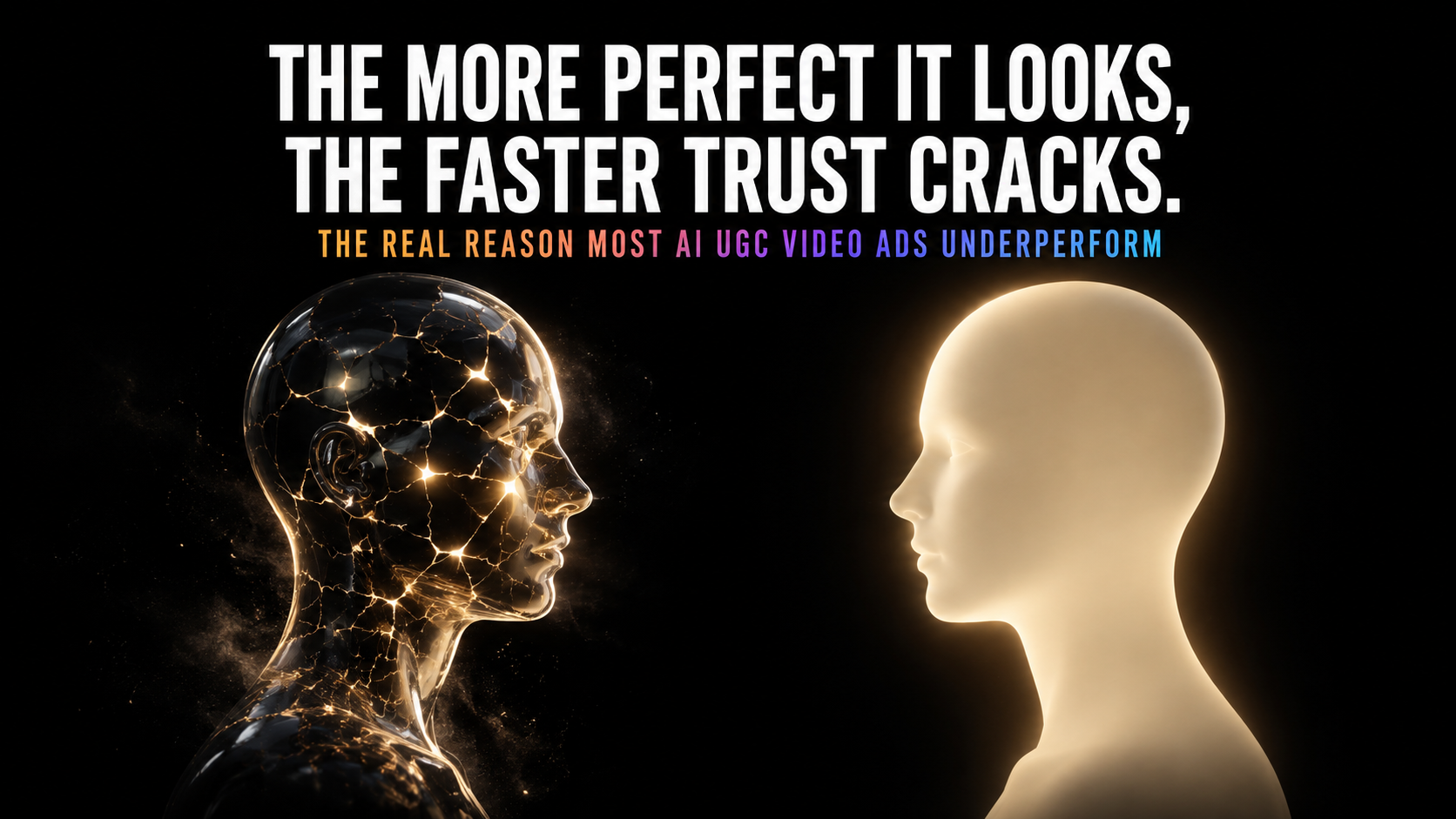
Scroll through any discussion of AI UGC video ads and the conversation almost always centers on avatar realism, how lifelike the AI actor looks, how natural the lip sync is, whether viewers can tell it's synthetic. This focus is understandable but largely misplaced. Testing AI UGC video ads across different product categories consistently shows that avatar quality is a secondary factor in whether these ads actually convert. The primary factor is something almost nobody talks about: whether the underlying script reasons through the product's category before writing, or applies one generic persuasive structure regardless of what's actually being sold. For brands evaluating this format seriously, platforms building category aware script generation into their ai ugc video ads tend to close the performance gap with real creator content far more reliably than tools optimizing purely for rendering quality.
This piece walks through why category matters more than avatar polish, what a category aware script actually looks like in practice, and how to evaluate whether a given AI UGC video ad platform is solving the right problem.
Why Avatar Quality Gets All the Attention and Deserves Less of It
It makes intuitive sense that avatar realism would be the deciding factor in AI UGC video ad performance. A viewer who immediately clocks an ad as obviously synthetic seems less likely to trust whatever claim it's making. This intuition isn't entirely wrong, but it overstates how much avatar quality alone actually drives conversion once a baseline level of realism is cleared.
The more consistent driver of performance turns out to be whether the script's persuasive structure actually fits the product category. A highly polished, lifelike avatar delivering a script that's mismatched to its category, applying a casual, low-structure opener to a trust-dependent supplement, for instance, tends to underperform a slightly less polished avatar delivering a script that correctly reasons through that category's specific persuasion problem. Avatar realism matters at the margins. Script structure matters at the core.
The Three Category Types That Actually Determine Script Structure
Products don't all face the same persuasion problem, and treating them as if they do is the single most common mistake in AI UGC video ad production. Trust-dependent categories, supplements, personal finance products, health items, carry inherited audience skepticism built up over years of overpromising marketing in exactly those spaces. A script for this category needs to name and directly resolve that skepticism, typically through a specific, checkable claim rather than a vague assertion.
Visible-result categories, skincare, beauty, fitness, carry a built-in advantage the trust-dependent categories don't have: the product's own demonstrated outcome does real persuasive work independent of who's delivering the message. A script here can lean into a straightforward demonstration without needing the heavier objection-handling structure a supplement genuinely requires.
Low-consideration categories, fashion accessories, small home goods, tolerate the lightest script structure of the three. The purchase risk is low enough that a casual, native-feeling ad performs comparably to a heavily engineered one, sometimes better, since over-structuring a low-stakes pitch can read as trying too hard relative to what the decision actually needs.
What a Category-Blind Script Generator Actually Produces
Most AI UGC video ad tools generate scripts from a prompt or product description without any explicit reasoning step tied to category. The result is fluent, grammatically correct text that reads perfectly fine in isolation and applies the same underlying structure regardless of what's being sold. Run a supplement, a skincare product, and a fashion accessory through this kind of tool, and the three scripts that come back will typically share the same persuasive shape, differing mainly in surface wording and product name rather than in actual structural approach.
This is the exact failure mode that produces disappointing AI UGC video ad performance, and it's specifically hard to catch by reading the script alone. A category-blind script can look complete and professional. The mismatch only becomes visible once real ad spend is behind it and conversion numbers come back lower than expected, at which point the natural instinct is often to blame the avatar or the platform's rendering quality rather than the actual root cause sitting in the script's underlying structure.
The Four Components a Complete Script Actually Needs
Beyond category reasoning, a functional AI UGC video ad script needs more than a spoken line. Four components together determine whether a script actually performs once it's rendered into video: the spoken line itself, a specific visual direction describing what should be happening on screen, on-screen text reinforcing the core message, since a meaningful share of social video gets watched with sound off initially, and a physical action for the avatar to perform while delivering the line.
A strong spoken line paired with no visual direction and no supporting action consistently underperforms the identical line paired with deliberate direction on both. Treating script generation as a purely text-based task, which is what most AI UGC video ad tools still do by default, misses this entire dimension of what actually makes a script function once it's performed on camera rather than read silently.
How to Actually Test Whether a Tool Reasons Through Category
The most reliable way to evaluate any AI UGC video ad platform's claim to be category-aware isn't reading its marketing page, it's running an actual comparison test. Submit a trust-dependent product, a visible-result product, and a low-consideration product through the exact same workflow, and compare the resulting scripts specifically for structural difference, not just wording changes.
If all three scripts share the same underlying persuasive shape with only the product name and surface details changed, the tool is applying one template through a fill-in-the-blank process, regardless of how sophisticated its marketing language sounds. If the three scripts genuinely differ in structural approach, one leading with objection-handling, one leading with a demonstration, one running casual and low-structure, that's a real signal the platform is doing the harder reasoning work category-aware script generation actually requires.
Why This Test Matters More Than Any Feature Comparison
Feature comparison charts for AI UGC video ad tools tend to focus on avatar count, language support, and rendering speed, all genuinely useful specifications but none of them answer the actual question that determines whether a specific ad converts: does the script fit the product it was written for. A platform with five hundred avatars and forty supported languages still produces disappointing results if every script it generates follows the same generic structure regardless of category.
Running the three-category comparison test described above takes roughly the same time as reading a feature comparison page, and it answers a question no feature list can. This is worth doing before committing to any AI UGC video ad platform for meaningful ad spend, since the cost of discovering a category mismatch after real budget has already gone out behind mismatched creative is considerably higher than the ten minutes a proper evaluation test requires.
The Cost Advantage That Makes Testing Volume Realistic in the First Place
None of this category reasoning matters if a brand can't actually afford to test multiple angles across multiple categories in the first place, which is where AI UGC video ads earn their real economic advantage over traditional creator production. AI generated UGC typically costs 0.40 to 2.50 dollars per rendered video, against 150 to 500 dollars for a comparable real creator production, a gap large enough to fundamentally change how much genuine angle testing a brand can realistically run.
This cost advantage is precisely why category-aware script generation matters so much specifically for AI UGC video ads and less for traditional creator content. A human strategist briefing a real creator naturally reasons through category as part of writing the brief, since that reasoning is baked into how an experienced marketer thinks about persuasion. An AI tool generating scripts at volume needs that same reasoning built into the tool itself, or the cost advantage that makes high-volume testing possible in the first place gets squandered on scripts that don't actually reflect real strategic thinking about what each specific product needs.
Where Real Creator Content Still Holds an Advantage
It's worth being direct about where AI UGC video ads, even category-aware ones, still face real limitations relative to traditional creator content. In deeply trust-dependent categories with sophisticated, skeptical audiences, a real creator's established credibility and track record can provide persuasive value an AI avatar cannot fully replicate, regardless of how well the underlying script reasons through category context. Categories requiring a genuine physical demonstration under conditions difficult to simulate convincingly may also favor real creator content, where an AI-generated version would read as less credible to an audience already primed for skepticism.
The practical conclusion isn't choosing one format exclusively. It's using AI UGC video ads for what their cost and speed advantage makes them genuinely good at, wide, fast, structurally distinct angle testing across a full product catalog, while reserving real creator production specifically for the categories and angles where that investment demonstrably earns back its added cost.
What to Actually Look for When Evaluating This Format
Anyone evaluating AI UGC video ads for their own brand should prioritize checking for category reasoning over avatar realism when comparing platforms, run the three-category comparison test described earlier rather than relying on marketing claims, and treat the four-component script structure, spoken line, visual, on-screen text, action, as a baseline requirement rather than a nice-to-have feature. A platform that gets these fundamentals right will consistently outperform one optimizing primarily for rendering fidelity, even if the latter produces marginally more realistic looking avatars in isolation.
The format itself has genuinely proven value. The gap between AI UGC video ads that convert well and ones that quietly underperform almost never comes down to how the avatar looks. It comes down to whether the script behind that avatar actually reasoned through what that specific product needed to say, and to whom, before a single word got written.
A Worked Example That Makes the Difference Concrete
Consider two versions of an AI UGC video ad for a probiotic supplement. The category-blind version, generated from a generic prompt with no category reasoning, might produce a spoken line like "This has genuinely changed my daily routine, I can't recommend it enough." Fluent, positive, entirely generic. It could apply to almost any product in almost any category with only the noun swapped out, which is exactly the tell that no real category-specific reasoning went into producing it.
The category-aware version, generated by a tool that first detected this product as trust-dependent, produces something structurally different: "I tried three other probiotics before this one, none of them had a strain count that actually matched what the research recommends." This version does real persuasive work a generic positive statement cannot. It preemptively acknowledges the skepticism a supplement buyer likely already holds, having been burned by overhyped products before, and answers that skepticism with a specific, checkable detail rather than a vague endorsement. The second version isn't just better writing. It's solving a genuinely different, harder problem the first version never actually attempts to address.
Why This Pattern Holds Across Multiple Categories, Not Just Supplements
The supplement example above illustrates the pattern most clearly because trust-dependent categories show the largest gap between category-aware and category-blind script performance. But the same underlying logic applies across every category, just with a different specific mechanism. A skincare script that ignores category context might lead with a generic claim about effectiveness, missing the far stronger persuasive lever available in this specific category: a visible, demonstrable result the viewer can judge independently of the spoken claim entirely. A fashion accessory script that over-applies heavy objection-handling structure, appropriate for a supplement, wastes the low-consideration nature of that specific purchase decision, potentially making a simple, low-stakes product feel more complicated to buy than it actually is.
In each case, the failure mode is the same: applying a persuasive structure that doesn't match what that specific category's audience actually needs to hear. The specific mechanism differs by category, but the underlying diagnosis, a mismatch between script structure and category-specific persuasion problem, is consistent across all three.
The Practical Cost of Getting This Wrong at Scale
A single mismatched script is a minor, correctable mistake. The real cost shows up once a brand scales AI UGC video ad production across a full catalog without category-aware reasoning built into the process. A brand running ten different products through a category-blind script generator will likely produce ten scripts sharing a similar underlying structure, regardless of how different those ten products actually are in terms of what they need to persuade their specific audiences.
This compounds into a genuinely significant amount of wasted testing budget over time, since each mismatched script represents an angle that was tested and likely underperformed, not because the underlying product or offer was weak, but because the script never gave that specific product a fair chance to make its actual best case to its actual audience. Catching this pattern early, before scaling production across an entire catalog, is considerably cheaper than discovering it gradually through a string of underwhelming campaign results across multiple products.
Building Category Awareness Into Your Own Evaluation Process
For any team currently running or considering AI UGC video ads at scale, building a simple category-mapping step into the workflow, independent of which specific tool generates the scripts, pays for itself quickly. Before generating any script, explicitly classify the product as trust-dependent, visible-result, or low-consideration based on genuine knowledge of that category's audience, not just an industry label. Use that classification to sanity-check whatever script comes back, does the structure actually match what this category's audience needs to hear, or does it read like a generic template with the product name inserted.
This manual check works as a safeguard regardless of which specific AI UGC video ad platform is generating the underlying scripts, and it catches exactly the failure mode described throughout this piece before real ad spend goes out behind creative that was never actually built to solve that specific product's persuasion problem in the first place.

 English
 Arabic
 French
 Spanish
 Portuguese
 Deutsch
 Turkish
 Dutch
Dutch
 Italiano
 Russian
 Romaian
 Greek
Greek