


How Professional Certifications Can Improve Internet Research Skills
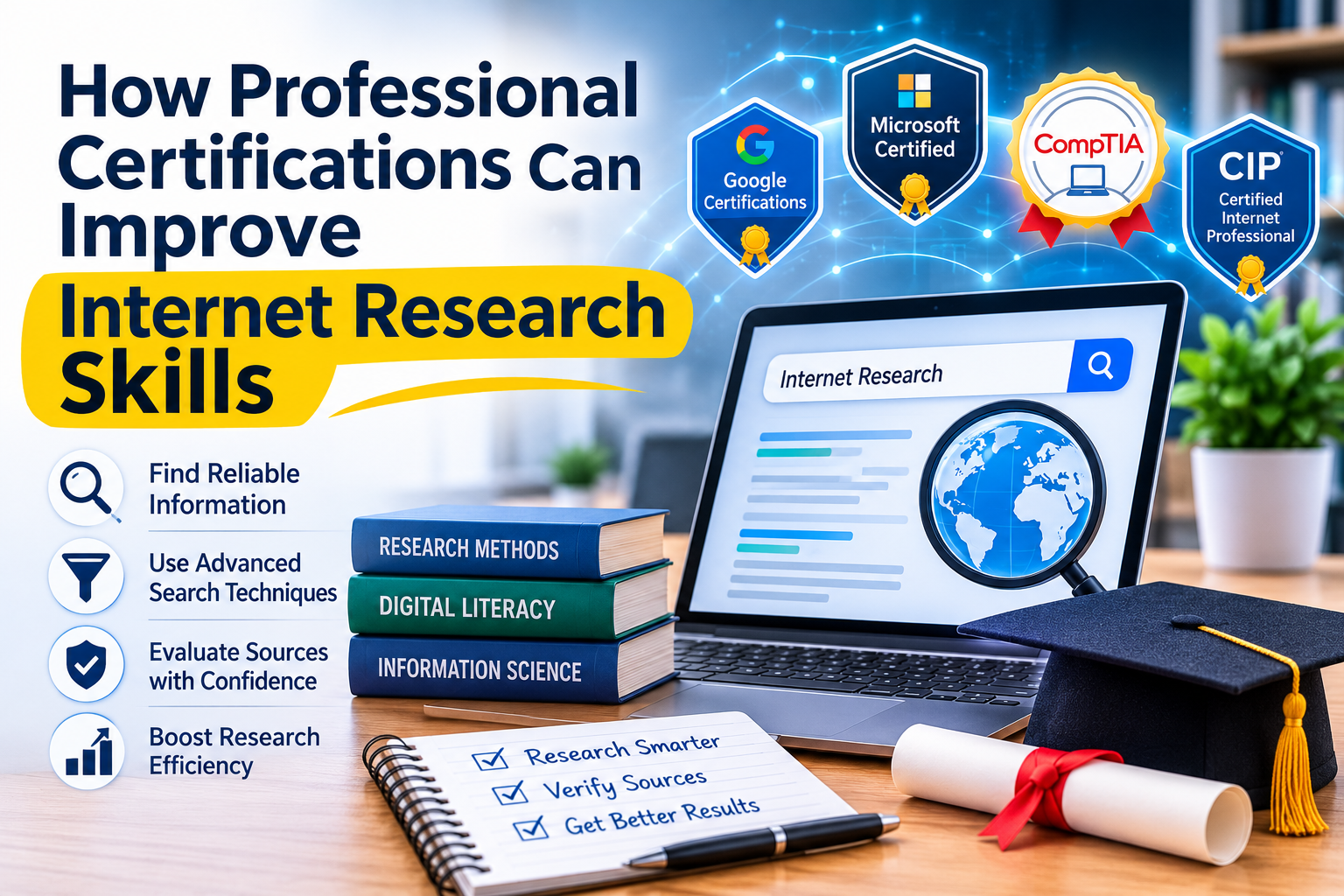
The internet provides access to an enormous amount of information, making research easier and more convenient than ever. However, finding accurate, relevant, and reliable information can be challenging. Search engines display millions of results, but not every source provides trustworthy or useful details. Developing strong internet research skills requires more than knowing how to search for information. It also involves evaluating sources, identifying credible evidence, organizing findings, and presenting information effectively.
Professional certifications can help individuals develop these abilities through structured learning, practical exercises, and industry recognized standards. Whether someone works in education, business, marketing, journalism, or technology, improving research skills can support better decision making and professional growth.
Understanding the Importance of Internet Research Skills
Internet research involves finding, evaluating, analyzing, and using information available through online resources. These skills are valuable in almost every professional environment because businesses and individuals regularly depend on digital information.
For example, marketing professionals research customer behavior, competitors, and industry trends before developing campaigns. Students use online libraries and academic databases to support assignments, while business owners investigate market opportunities before making important decisions.
Effective research requires the ability to distinguish reliable information from misleading content. Without proper evaluation skills, individuals may rely on inaccurate statistics, outdated information, or unsupported claims.
Professional learning can provide a structured approach to developing these essential abilities.
How Professional Certifications Build Research Knowledge
Professional certifications introduce learners to established research methods and practical techniques. Instead of relying entirely on personal experience, individuals follow organized learning programs that explain how to approach research tasks.
A certification in research can help learners understand information gathering, source evaluation, data interpretation, and evidence based reporting.
These programs may also introduce specialized research tools and digital resources that improve efficiency. Learners become familiar with different information sources and understand how to select the most appropriate resources for specific research objectives.
The structured nature of certification programs helps individuals identify weaknesses and develop consistent research practices.
Developing Better Search Strategies
One of the most important internet research skills is knowing how to search effectively. Many people enter general phrases into search engines and spend considerable time reviewing irrelevant results.
Professional training can teach individuals how to develop more focused search queries.
For example, using specific keywords, quotation marks, and advanced search operators can help narrow search results. Learners may also discover how to search academic databases, government websites, industry publications, and specialized research platforms.
Understanding search intent is equally important. A person researching industry statistics needs different sources from someone looking for practical product comparisons.
By learning these techniques, individuals can locate relevant information more quickly and spend less time reviewing unnecessary results.
Learning to Identify Reliable Information Sources
Not all online information is equally trustworthy. Websites may publish inaccurate claims, outdated statistics, or content that reflects personal opinions rather than verified evidence.
Professional certifications can improve the ability to evaluate sources using clear criteria.
Important factors to consider include:
-
Author qualifications and relevant experience
-
Publication date and information freshness
-
Supporting evidence and references
-
Reputation of the publishing organization
-
Transparency about research methods
-
Potential conflicts of interest or commercial bias
For example, information published by an established government department may be more appropriate for researching official regulations than an anonymous online discussion.
However, source credibility also depends on the subject being researched. Academic publications, professional organizations, and industry reports each serve different purposes.
Learning how to evaluate these differences helps researchers make more informed decisions.
Improving Critical Thinking and Analytical Abilities
Collecting information is only one part of effective research. Individuals must also understand what the information means and how different findings relate to each other.
Critical thinking helps researchers question assumptions, identify inconsistencies, and examine evidence before reaching conclusions.
Professional certification programs may include activities that require learners to compare multiple sources, interpret findings, and recognize misleading arguments.
For instance, two industry reports may present different statistics because they use different research periods or measurement methods. Understanding these differences prevents incorrect comparisons.
Analytical abilities also help individuals recognize patterns and identify information gaps.
These skills are especially useful when research findings influence business strategies, academic projects, or professional recommendations.
Understanding Data Collection and Research Methods
Good internet research often involves gathering information from several sources. Depending on the objective, researchers may use surveys, interviews, online databases, published reports, or statistical resources.
Professional certifications can introduce learners to different research methods and explain when each approach is appropriate.
For example, qualitative research focuses on experiences, opinions, and behaviors, while quantitative research examines numerical information and measurable patterns.
Understanding these approaches helps individuals choose suitable methods for their research objectives.
Training can also improve awareness of sampling limitations, research bias, data accuracy, and ethical considerations.
This knowledge is particularly valuable for professionals who need to produce reports supported by credible findings.
Strengthening Information Organization and Reporting
Research becomes less effective when collected information is poorly organized. Researchers may find useful sources but struggle to remember where specific facts came from or how different findings connect.
Professional training can introduce practical methods for managing research materials.
These may include organizing digital documents, maintaining source records, creating research summaries, and using spreadsheets or reference management tools.
Clear reporting is another important skill. Research findings should be presented in a way that readers can understand without unnecessary complexity.
A well structured report generally includes a clear objective, relevant evidence, meaningful analysis, and logical conclusions.
Developing these abilities makes research more useful for both individual projects and professional collaboration.
Supporting Career Development and Professional Credibility
Strong research skills are valuable across multiple industries. Employers often look for professionals who can investigate problems, evaluate information, and communicate findings clearly.
Professional certifications provide evidence that an individual has invested time in developing relevant knowledge.
They may also help candidates demonstrate their commitment to continuous learning when applying for positions involving analysis, reporting, education, or business development.
However, certifications are most effective when supported by practical experience. Applying research methods to real projects helps learners understand how theoretical knowledge works in professional environments.
Combining training with hands on practice can strengthen confidence and improve workplace performance.
Adapting to New Research Technologies
Digital research tools continue to evolve. Artificial intelligence, advanced search platforms, academic databases, and data analysis software have changed how people collect and process information.
Professional learning helps individuals understand these developments and use relevant technologies responsibly.
For example, AI powered tools can assist with summarizing documents, organizing information, and identifying potential research directions. However, their outputs still require verification because automated systems can produce inaccurate or incomplete information.
Researchers should also understand data privacy, copyright, proper attribution, and ethical information use.
Staying familiar with new technologies allows professionals to improve research efficiency without compromising accuracy or credibility.
Conclusion
Professional certifications can play an important role in improving internet research skills by providing structured knowledge, practical training, and recognized learning standards.
They help individuals develop better search strategies, evaluate information sources, strengthen critical thinking, understand research methods, and organize findings effectively.
These abilities are valuable in academic, business, and professional environments where accurate information supports important decisions.
However, completing a certification is only the beginning. Consistent practice, curiosity, and a commitment to learning are essential for becoming an effective researcher.
By combining professional training with real world experience, individuals can develop stronger internet research skills and use online information more confidently, accurately, and responsibly.

 English
 Arabic
 French
 Spanish
 Portuguese
 Deutsch
 Turkish
 Italiano
 Russian
 Romaian
 Portuguese (Brazil)
 Greek